Advertisements
Advertisements
प्रश्न
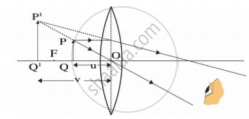 : Object near the lens : : ______ :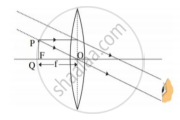
Advertisements
उत्तर
: Object near the lens : : Object at focus :
APPEARS IN
संबंधित प्रश्न
Draw a ray diagram to show the formation of image in the above situation
A student focuses the image of a well-illuminated distant object on a screen using a convex lens. After that, he gradually moves the object towards the lens and each time focuses its image on the screen by adjusting the lens.
(i) In which direction, towards the screen or away from the screen, does he move the lens?
(ii) What happens to the size of the image? Does it decrease or increase?
(iii) What happens to the image on the screen when he moves the object very close to the lens?
A student has obtained a magnified image of a flame on a screen using a convex lens. To draw the corresponding ray diagram to show the image formation, which of the following two rays whose paths after refraction are shown, should he select ?
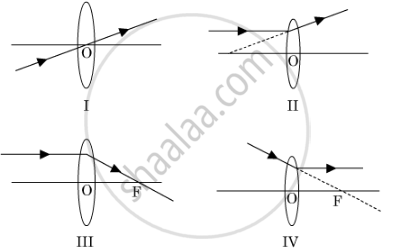
(A) I and II
(B) II and III
(C) III and IV
(D) I and III
Which of the following lenses would you prefer to use while reading small letters found in a dictionary?
When a ray of light enters from one medium to another having different optical densities it bends. Why does this phenomenon occur?
Where should an object be placed so that a real and inverted image of the same size as the object is obtained using a convex lens?
An object is placed at a distance equal to 2f in front of a convex lens. Draw a labelled ray diagram to show the formation of image. State two characteristics of the image formed.
Describe with the help of a ray diagram the nature, size and position of the image formed when an object is placed at infinity (considerable distance) in front of a convex lens. State three characteristics of the image so formed.
List some things that convex lens and concave mirror have in common.
A convex lens of focal length 0.10 m is used to form a magnified image of an object of height 5 mm placed at a distance of 0.08 m from the lens. Calculate the position, nature and size of the image.
Complete the following sentence.
A long-sighted person cannot see ........... objects clearly. Long-sightedness can be corrected by using .............. lenses.
The focal length of a thin convex lens is ______ than that of a thick convex lens.
A converging lens forms the image of an object placed in front of it, beyond 2F2 of the lens. Draw a ray diagram to show the formation of the image.
Distinguish between:
Concave lens and Convex lens
Draw neat diagram to show the
Convergent action of a convex lens,
State the position of object, position of image, nature of image when: Convex lens is used in observing biological specimens.
A candle is placed between f and 2f a convex lens. Draw a ray diagram showing the position of the image.
A beam of light is incident through the holes on side A and emerges out of the holes on the other face of the box as show in the figure. Which of the following could be inside the box?

