Advertisements
Advertisements
प्रश्न
Simple microscope : Number of convex lens one : : compound microscope : _______
Advertisements
उत्तर
Simple microscope : Number of convex lens one : : compound microscope : Number of convex lenses two
APPEARS IN
संबंधित प्रश्न
(a) Draw a ray diagram to show the formation of an image by a convex lens when an object is placed in front of the lens between its optical centre and principal focus.
(b) In the above ray diagram, mark the object distance (u) and the image distance (v) with their proper signs (+ve or –ve as per the new Cartesian sign convention) and state how these distances are related to the focal length (f) of the convex lens in this case.
(c) Find the power of a convex lens which forms a real and inverted image of magnification –1 of an object placed at a distance of 20 cm from its optical centre.
To determine the approximate focal length of the given convex lens by focussing a distant object (say, a sign board), you try to focus the image of the object on a screen. The image you obtain on the screen is always
(a) erect and laterally inverted
(b) erect and diminished
(c) inverted and diminished
(d) virtual, inverted and diminished
"A convex lens can form a magnified erect as well as magnified inverted image of an object placed in front of it." Draw ray diagram to justify this statement stating the position of the object with respect to the lens in each case.
Complete the following table:
| Instrument | Number of Convex Lenses |
Use |
| Simple Microscope | .............. | .............. |
| Compound Microscope | .............. | .............. |
| Telescope | .............. | .............. |
Draw a labelled ray diagram to show how a ray of light is refracted when it passes:
from air into an optically denser medium.
Draw a labelled ray diagram to show how a ray of light passes through a parallel-sided glass block if it hits the glass block at 90° (that is, perpendicular to the glass block).
For what position of an object a real, diminished image is formed by a convex lens?
An object is placed at a distance equal to 2f in front of a convex lens. Draw a labelled ray diagram to show the formation of image. State two characteristics of the image formed.
In order to obtain a real image twice the size of the object with a convex lens of focal length 15 cm, the object distance should be:
(a) more than 5 cm but less than 10 cm
(b) more than 10 cm but less than 15 cm
(c) more than 15 cm but less than 30 cm
(d) more than 30 cm but less than 60 cm
What kind of lens can form:
an inverted diminished image?
An object is placed 20 cm from (a) a converging lens, and (b) a diverging lens, of focal length 15 cm. Calculate the image position and magnification in each case.
What type of lens is used to correct
hypermetropia
A convex lens forms an image of an object equal to the size of the object. State two more characteristics of the image.
Complete the following table:
| Type of lens | Position of object | Nature of image | Size of image |
| Convex | Between optical centre and focus | ||
| Convex | At focus | ||
| Concave | At infinity | ||
| Concave | At any distance |
State the position of object, position of image, nature of image when: Convex lens is used as objective lens of photographic camera.
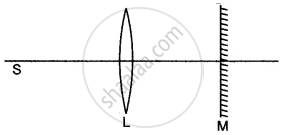
In the figure given below L is a convex lens, M is a plane mirror and S is a point source of light. Rays of light from the source S return to their point of origin. Complete the ray diagram to show this. What is the point S called?
A candle is placed between f and 2f a convex lens. Draw a ray diagram showing the position of the image.
Find the odd one out and give its explanation.
Which of the following statements is true?
Distinguish between:
Concave lens and Convex Lens
