Advertisements
Advertisements
प्रश्न
Nearsightedness : concave lens : : farsightedness : _______
Advertisements
उत्तर
Nearsightedness : concave lens : : farsightedness : convex lens
APPEARS IN
संबंधित प्रश्न
Millions of people in the developing countries of the world are suffering from corneal blindness. These persons can be cured by replacing the defective cornea with the cornea of a donated eye. A charitable society of your city has organised a campaign in your neighbourhood in order to create awareness about this fact. If you are asked to participate in this mission, how would you contribute in this noble cause?
(i) State the objective of organising such campaigns.
(ii) List two arguments which you would give to motivate the people to donate their eyes after death.
(iii) List two values which are developed in the persons who actively participate and contribute in such programmes.
About 45 lac people in the developing countries are suffering from corneal blindness. About 30 lac children below the age of 12 years suffering from this defect can be cured by replacing the defective cornea with the cornea of a donated eye. How and why can students of your age involve themselves to create awareness about this fact among people?
A student suffering from myopia is not able to see distinctly the objects placed beyond 5 m. List two possible reasons due to which this defect of vision may have arisen. With the help of ray diagrams, explain
(i) why the student is unable to see distinctly the objects placed beyond 5 m from his eyes.
(ii) the type of the corrective lens used to restore proper vision and how this defect is corrected by the use of this lens.
(b) If, in this case, the numerical value of the focal length of the corrective lens is 5 m, find the power of the lens as per the new Cartesian sign convention
Name the defect of vision in a person:
whose far point is less than infinity
What is the scientific name of
short-sightedness
What is the other name of old age hypermetropia?
Name one defect of vision (or eye) which cannot be corrected by any type of spectacle lenses.
A student sitting in the last row of the class-room is not able to read clearly the writing on the blackboard.
- Name the type of defect he is suffering from.
- How can this defect by corrected?
Name the defect of vision which can be corrected by a converging lens. Show clearly by a ray diagram how the lens corrects the defect.
The defect of vision in which the eye-lens of a person gets progressively cloudy resulting in blurred vision is called:
(a) myopia
(b) presbyopia
(c) colourblindness
(d) cataract
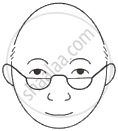
The picture given here shows a person wearing ‘half-moon’ spectacles. What sort of eye-defect do you think he has? Why are these particular spectacles useful to him?
The near point of a long-sighted person is 50 cm from the eye.
- Can she see clearly an object at:
- a distance of 20 cm?
- at infinity?
- To read a book held at a distance of 25 cm, will she need converging or diverging spectacle lenses?
A person can read a book clearly only if he holds it at an arm's length from him. Name the defect of vision:
if the person is a young man
Which part of the eye is grafted in a needy patient from a donated eye?
By closing the eyes and gently pressing them by your palms, you may see some specks of brilliant light. How do you get this sensation while there is no light entering your eyes?
You do not enjoy watching a movie from a very short distance from the screen in a cinema hall. Why?
State one role of ciliary muscles in the human eye.
Draw a ray diagram to show how Hypermetropia is defect can be corrected using a lens.
State the main functions of the following:
Tears
Name the following:
The photosensitive pigment present in the rod cells of the retina.
Given alongside is a diagram depicting a defect of the human eye. Study the same and then answer the questions that follow:
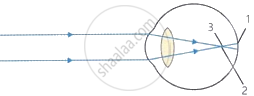
- Identify the defect.
- Name the parts labelled 1, 2 and 3.
- Give two possible reasons for this eye defect.
- Draw a labelled diagram to show how the above mentioned defect is rectified.
The diagram alongside represents a section of a mammalian eye.
(i) Label the parts 1 to 5 of the diagram.
(ii) State the function of the parts labelled 4 and 5.
(iii) With the help of a diagram show the short sightedness.

A person is unable to see objects distinctly placed within 50 cm from his eyes.
(a) Name the defect of vision the person is suffering from and list its two possible causes.
(b) Draw a ray diagram to show the defect in the above case.
(c) Mention the type of lens used by him for the correction of the defect and calculate its power. Assume that the near point for the normal eye is 25 cm.
(d) Draw a labeled diagram for the correction of the defect in the above case.
Name the common defects of the eye.
Differentiate between:
Short-sightedness and Long-sightedness.
Give Technical Term:
The type of lens used to correct myopia is
What type of lens is used to correct Astigmatism?
What type of lens is used to correct Hypermetropia?
The diagram given below represents the cross-section of the human eye:

(i) Name the parts labeled 1—12.
(ii) What is the function of the part marked ‘10’?
(iii) What would happen if part ‘5’ is damaged or cut?
Study the following diagram carefully and then answer the questions that follow. The diagram is depicting a defect of the human eye :

(i) Identify the defect shown in the diagram.
(ii) Give two possible reasons for the above defect.
In Myopia the human eye _______.
Draw ray diagram showing myopic eye.
Observe the following diagram and answer questions following it:

- Identify the defect of vision shown.
- List its two causes.
- Name the type of lens used for the correction of this defect.
