Advertisements
Advertisements
प्रश्न
Object at 2F1 of a convex lens : Image at 2F2 : : Object at F1 : _______
Advertisements
उत्तर
Object at 2F1 of a convex lens : Image at 2F2 : : Object at F1 : Image at infinity
APPEARS IN
संबंधित प्रश्न
To determine the approximate focal length of the given convex lens by focussing a distant object (say, a sign board), you try to focus the image of the object on a screen. The image you obtain on the screen is always
(a) erect and laterally inverted
(b) erect and diminished
(c) inverted and diminished
(d) virtual, inverted and diminished
A student wants to project the image of a candle flame on the walls of school laboratory by using a lens:-
(a) Which type of lens should be use and why?
(b) At what distance in terms of focal length 'F' of the lens should be place the candle flame so as to get (i) a magnified, and (ii) a diminished image respectively on the wall?
(c) Draw ray diagram to show the formation of the image in each case?
Where should an object be placed so that a real and inverted image of the same size as the object is obtained using a convex lens?
A beam of light travelling in air is incident of water. Draw a ray-diagram indicating the change in its path in water.
A 1 cm high object is placed at a distance of 2f from a convex lens. What is the height of the image formed?
Describe with the help of a ray diagram the nature, size and position of the image formed when an object is placed at infinity (considerable distance) in front of a convex lens. State three characteristics of the image so formed.
You eye contains a convex lens. Why is it unwise to look at the sun?
A student did an experiment with a convex lens. He put an object at different distances 25 cm, 30 cm, 40 cm, 60 cm and 120 cm from the lens. In each case he measured the distance of the image from the lens. His results were 100 cm, 24 cm, 60 cm, 30 cm and 40 cm, respectively. Unfortunately his results are written in wrong order.
- Rewrite the image distances in the correct order.
- What would be the image distance if the object distance was 90 cm?
- Which of the object distances gives the biggest image?
- What is the focal length of this lens?
The given below figure shows an object OA and its image IB formed by a lens. State three characteristics of the image.
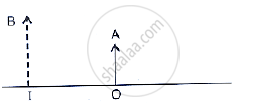
A lens forms an upright and magnified image of an object. Name the lens.
In the following cases, where must an object be placed in front of a convex lens so that the image formed is of the same size as the object?
In the following cases, where must an object be placed in front of a convex lens so that the image formed is upright and enlarged?
State two applications of a convex lens.
A pin 2 cm long is placed 12 cm away from a convex lens at right angles to the principal axis. If the focal length of the lens is 20 cm, by scale drawing find the size of the image and its magnification.
Point out the difference between a convex lens and a concave lens.
Why do we say that the ‘2F’ and ‘F’ points of a convex lens can be regarded as a sort of ‘turning points’ as far as the nature of the image formed by it is concerned?
Draw a ray diagram to illustrate the determination of the focal length of a convex lens using an auxiliary plane mirror.
Diagram shows an object AB placed on the principal axis B of a convex lens placed in air. F1 and F2 are the two foci of the lens.
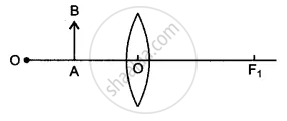
(i) Copy the diagram:
Draw a ray of light starting from B and passing through O. Show the same ray after refraction by the lens. Draw another ray from B which passes through F2 after refraction by the lens. Locate the final image
(ii) Is the image real or virtual?
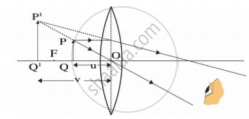 : Object near the lens : : ______ :