Advertisements
Advertisements
Question
Object at 2F1 of a convex lens : Image at 2F2 : : Object at F1 : _______
Advertisements
Solution
Object at 2F1 of a convex lens : Image at 2F2 : : Object at F1 : Image at infinity
APPEARS IN
RELATED QUESTIONS
An object 5 cm in length is held 25 cm away from a converging lens of focal length 10 cm. Draw the ray diagram and find the position, size and the nature of the image formed.
Draw a labelled ray diagram to show how a ray of light is refracted when it passes:
from an optically denser medium into air.
The diagram given alongside shows a ray of light entering a rectangular block of glass.
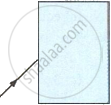
- Copy the diagram and draw the normal at the point of entry.
- Draw the approximate path of the ray of light through the glass block and out of the other side.
Explain with the help of a diagram, why the convex lens is also called a converging lens.
Define the principal axis of a convex lens.
Draw a ray diagram to show the formation of a real magnified image by a convex lens. (In your sketch the position of object and image with respect to the principal focus of lens should be shown clearly).
A convex lens has a focal length of 10 cm. At which of the following positions should an object be placed so that this convex lens may act as a magnifying glass?
A student did an experiment with a convex lens. He put an object at different distances 25 cm, 30 cm, 40 cm, 60 cm and 120 cm from the lens. In each case he measured the distance of the image from the lens. His results were 100 cm, 24 cm, 60 cm, 30 cm and 40 cm, respectively. Unfortunately his results are written in wrong order.
- Rewrite the image distances in the correct order.
- What would be the image distance if the object distance was 90 cm?
- Which of the object distances gives the biggest image?
- What is the focal length of this lens?
What kind of lens can form:
an inverted magnified image?
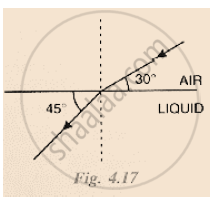
The diagram alongside shows the refraction of a ray of light from sir to a liquid.
(a) write the values of (i) angle of incidence, (ii) angle of refraction.
(b) use snell’s law to find the refractive index of liquid with respect to air.
A lens forms an inverted image of an object. Name the kind of lens.
A lens forms an upright and magnified image of an object. Name the lens.
An object is placed perpendicular to the principal axis of a convex lens of focal length 20 cm. The distance of the object from the lens is 30 cm. Find (i) the position (ii) the magnification and (iii) the nature of the image formed.
If an object is placed in front of a convex lens beyond 2F1, then what will be the position, relative size, and nature of an image which is formed? Explain with a ray diagram.
Answer the following question.
List four precautions which a student should observe while determining the focal length of a given convex lens by obtaining an image of a distant object on a screen.
State the position of object, position of image, nature of image when: Convex lens is used as objective lens of photographic camera.
State the position of object, position of image, nature of image when: Convex lens is used as in searchlight.
- In which type of microscope do you find the lens arrangement as shown in the following diagram?

- Write about the working and the use of this microscope.
Distinguish between:
Concave lens and Convex Lens
