Advertisements
Advertisements
प्रश्न
Object at 2F1 of a convex lens : Image at 2F2 : : Object at F1 : _______
Advertisements
उत्तर
Object at 2F1 of a convex lens : Image at 2F2 : : Object at F1 : Image at infinity
APPEARS IN
संबंधित प्रश्न
An object of height 2.5 cm is placed at a distance of 15 cm from the optical centre 'O' of a convex lens of focal length 10 cm. Draw a ray diagram to find the position and size of the image formed. Mark optical 'O', principal focus F and height of the image on the diagram.
Study the given ray diagrams and select the correct statement from the following:
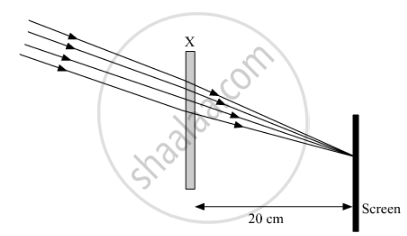
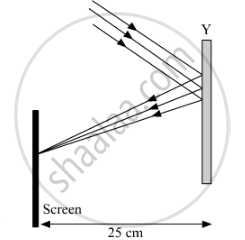
(A) Device X is a concave mirror and device Y is a convex lens, whose focal lengths are 20 cm and 25 cm respectively.
(B) Device X is a convex lens and device Y is a concave mirror, whose focal lengths are 10 cm and 25 cm respectively.
(C) Device X is a concave lens and device Y is a convex mirror, whose focal lengths are 20 cm and 25 cm respectively.
(D) Device X is a convex lens and device Y is a concave mirror, whose focal lengths are 20 cm and 25 cm respectively.
Draw a labelled ray diagram to show how a ray of light passes through a parallel-sided glass block if it hits the glass block at 90° (that is, perpendicular to the glass block).
For what position of an object a real, diminished image is formed by a convex lens?
If an object is at a considerable distance (or infinity) in front of a convex lens, where is the image formed?
A convex lens of focal length 8 cm forms a real image of the same size as the object. The distance between object and its image will be:
An object 4 cm high is placed at a distance of 10 cm from a convex lens of focal length 20 cm. Find the position, nature and size of the image.
Define the term principal axis of a lens.
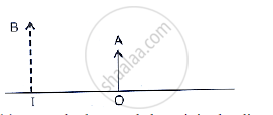
The given below figure shows an object OA and its image IB formed by a lens.
Complete the following table:
| Type of lens | Position of object | Nature of image | Size of image |
| Convex | Between optical centre and focus | ||
| Convex | At focus | ||
| Concave | At infinity | ||
| Concave | At any distance |
Analyse the following observation table showing variation of image-distance (v) with object-distance (u) in case of a convex lens and answer the questions that follow without doing any calculations:
| S. No. | Object-Distance u (cm) |
Image-Distance v (cm) |
| 1 | –60 | +12 |
| 2 | –30 | +15 |
| 3 | –20 | +20 |
| 4 | –15 | +30 |
| 5 | –12 | +60 |
| 6 | –9 | +90 |
(a) What is the focal length of the convex lens? State reason for your answer.
(b) For what object-distance (u) is the corresponding image-distance (v) not correct? How did you arrive at this conclusion?
(c) Choose an appropriate scale to draw a ray diagram for the observation at S. No. 4 and find the approximate value of magnification.
List four properties of the image formed by a convex mirror.
For which position of the object does a convex lens form a virtual and erect image? Explain with the help of a ray diagram.
(a) What type of a lens can be used as a magnifying glass?
(b) Show by a ray diagram the formation of a real image by simple magnifying lens.
A convex lens forms an inverted image of size same as that of the object which is placed at a distance 60 cm in front of the lens. Find: The position of image
Why do we say that the ‘2F’ and ‘F’ points of a convex lens can be regarded as a sort of ‘turning points’ as far as the nature of the image formed by it is concerned?
Find the odd one out and give its explanation.
Write scientific reason.
Adults need bifocal lens spectacle.
A convex lens of focal length 20 cm can produce a magnified virtual as well as real image. Is this a correct statement? If yes, where shall the object be placed in each case for obtaining these images?

The above image shows a thin lens with a focal length of 5m.
- What is the kind of lens shown in the above figure?
- If a real inverted image is to be formed by this lens at a distance of 7m from the optical centre, then show with calculation where should the object be placed.
- Draw a neatly labelled diagram of the image formation mentioned in (ii).
