Advertisements
Advertisements
प्रश्न
A person is unable to see objects distinctly placed within 50 cm from his eyes.
(a) Name the defect of vision the person is suffering from and list its two possible causes.
(b) Draw a ray diagram to show the defect in the above case.
(c) Mention the type of lens used by him for the correction of the defect and calculate its power. Assume that the near point for the normal eye is 25 cm.
(d) Draw a labeled diagram for the correction of the defect in the above case.
Advertisements
उत्तर
(a) The defect of the vision is hypermetropia
Hypermetropia is caused due to:
(i) reduction in the curvature of the lens
(ii) a decrease in the size of the eyeball
(b) Ray diagram:
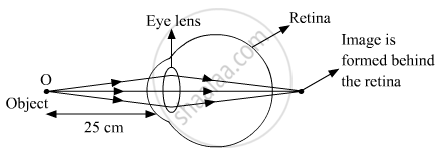
(c) The corrective lens used for this defect is a convex lens.
Given that the near point of the eye is at 50 cm. The convex lens should form the image of the object placed at the distance 25 cm on the near point of the defective eye.
v = −50 cm
u = −25 cm
`1/"f" = 1/"v"-1/"u"`
⇒ `1/"f"=1/((-50))-1/((-25))=1/50`
Power,`"P"=100/50=+2"D"`
(d) Ray diagram showing the correction of the defect:
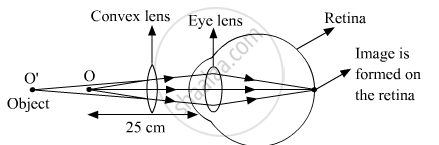
APPEARS IN
संबंधित प्रश्न
The far point of a myopic person is 80 cm in front of the eye. What is the nature and power of the lens required to correct the problem?
What is the other name of old age hypermetropia?
A man can read the number of a distant but clearly but he finds difficulty in reading a book.
What type of spectacle lens should he use to correct the defect?
Name the following:
The photosensitive pigment present in the rods of the retina.
State one role of ciliary muscles in the human eye.
Choose the odd one out from the following terms and name the category to which the others belong.
Endolymph, Tympanic membrane, Semi-circular canal, Blind spot
Given below is a diagram depicting a defect of the human eye? Study the same and answer the question that follow :
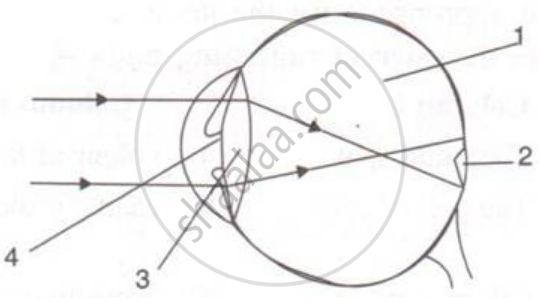
Name the type of lens used to correct this eye defect.
The near point of the eye of a person is 50 cm. Find the nature and power of the corrective lens required by the person to enable him to see clearly the objects placed at 25 cm from the eye?
Give Technical Term:
The type of lens used to correct myopia is
