Advertisements
Advertisements
Question
A person is unable to see objects distinctly placed within 50 cm from his eyes.
(a) Name the defect of vision the person is suffering from and list its two possible causes.
(b) Draw a ray diagram to show the defect in the above case.
(c) Mention the type of lens used by him for the correction of the defect and calculate its power. Assume that the near point for the normal eye is 25 cm.
(d) Draw a labeled diagram for the correction of the defect in the above case.
Advertisements
Solution
(a) The defect of the vision is hypermetropia
Hypermetropia is caused due to:
(i) reduction in the curvature of the lens
(ii) a decrease in the size of the eyeball
(b) Ray diagram:
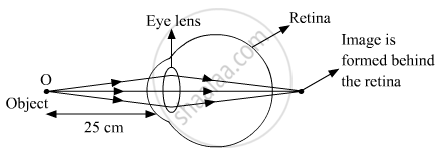
(c) The corrective lens used for this defect is a convex lens.
Given that the near point of the eye is at 50 cm. The convex lens should form the image of the object placed at the distance 25 cm on the near point of the defective eye.
v = −50 cm
u = −25 cm
`1/"f" = 1/"v"-1/"u"`
⇒ `1/"f"=1/((-50))-1/((-25))=1/50`
Power,`"P"=100/50=+2"D"`
(d) Ray diagram showing the correction of the defect:
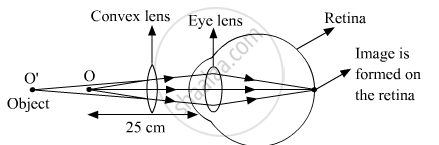
APPEARS IN
RELATED QUESTIONS
A student suffering from myopia is not able to see distinctly the objects placed beyond 5 m. List two possible reasons due to which this defect of vision may have arisen. With the help of ray diagrams, explain
(i) why the student is unable to see distinctly the objects placed beyond 5 m from his eyes.
(ii) the type of the corrective lens used to restore proper vision and how this defect is corrected by the use of this lens.
(b) If, in this case, the numerical value of the focal length of the corrective lens is 5 m, find the power of the lens as per the new Cartesian sign convention
Explain with the help of labelled ray diagram, the defect of vision called myopia and how it is corrected by a lens.
A short-sighted person has a near point of 15 cm and a far point of 40 cm.
(a) Can he see clearly an object at a distance of:
(i) 5 cm?
(ii) 25 cm?
(iii) 50 cm?
(b) To see clearly an object at infinity, what kind of spectacle lenses does he need?
Differentiate between members of the following pair with reference to what is asked in bracket.
Myopia and hyperopia (cause of the defect)
Describe the mechanism of focusing the image of a distant object in your eye when you raise your head after reading a book.
Explain the terms ‘adaptation’ and ‘accommodation’ with reference to the eye.
Given below is a diagrammatic representation of a defect of the human eye:

(i) Identify the defect.
(ii) Mention two reasons for the above defect.
(iii) State how the defect can be rectified.
(iv) Name the part of the eye responsible for maintaining the shape of the eyeball.
What are the causes of ‘Myopia’?
Assertion: Myopia is the defect of vision in which a person cannot see distant objects clearly.
Reason: This due to eye-ball being too short.
Observe the figure and answer the following questions:

- Name the defect of vision represented in the above figure.
- State the reasons for this defect.
- How is it corrected?
- Draw the diagram to show the correction of this defect.
