Advertisements
Advertisements
Question
A short-sighted person has a near point of 15 cm and a far point of 40 cm.
(a) Can he see clearly an object at a distance of:
(i) 5 cm?
(ii) 25 cm?
(iii) 50 cm?
(b) To see clearly an object at infinity, what kind of spectacle lenses does he need?
Advertisements
Solution
a) (i) A short-sighted person with a near point of 15 cm and a far point of 40 cm in front of the eye cannot clearly see an object at a distance of 5 cm because he can see an object only when it is placed at his near point (i.e., 15 cm).
(b) A short-sighted person can clearly see an object at a distance of 25 cm as it the normal near point of the eye. Moreover, the person's far point is located at 40 cm from the eye.
(c) The person cannot see the object clearly as it is at a distance of 50 cm, which is beyond his far point.
(d) In order to see an object clearly at infinity, the person should use concave lenses in his spectacles. A concave lens first diverges the light rays from the object at infinity to form a virtual image at the eye's far point. The eye lens then easily focusses the rays from the eye's far point to form a clear image on the retina.
APPEARS IN
RELATED QUESTIONS
Write the importance of ciliary muscles in the human eye. Name the defect of vision that arises due to gradual weakening of the ciliary muscles. What types of lenses are required by the person suffering from this defect to see the objects clearly?
Akshay, sitting in the last row in his class, could not see clearly the words write on the blackboard. When the teacher noticed it, he announced if any student sitting in the front row could volunteer to exchange his seat with Akshay. Salman immediately agreed to exchange his seat with Akshay. He could now see the words written on the blackboard clearly. The teacher thought it fit to send the message to Akshay’s parents advising them to get his eyesight checked.
In the context of the above event, answer the following questions:-
(a) Which defect of vision is Akshay suffering from? Which type of lens is used to correct this defect?
(b) State the values displayed by the teacher and Salman.
(c) In your opinion, in what way can Akshay express his gratitude towards the teacher and Salman?
List three common refractive defects of vision. Suggest the way of correcting these defects.
A student suffering from myopia is not able to see distinctly the objects placed beyond 5 m. List two possible reasons due to which this defect of vision may have arisen. With the help of ray diagrams, explain
(i) why the student is unable to see distinctly the objects placed beyond 5 m from his eyes.
(ii) the type of the corrective lens used to restore proper vision and how this defect is corrected by the use of this lens.
(b) If, in this case, the numerical value of the focal length of the corrective lens is 5 m, find the power of the lens as per the new Cartesian sign convention
The kind of lens required to correct Myopia
Name the defect of vision in a person:
whose far point is less than infinity
Name the defect of vision in which the eye-lens loses its power of accommodation due to old age.
Explain with the help of labelled ray diagram, the defect of vision called myopia and how it is corrected by a lens.
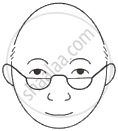
The picture given here shows a person wearing ‘half-moon’ spectacles. What sort of eye-defect do you think he has? Why are these particular spectacles useful to him?
A person can read a book clearly only if he holds it at an arm's length from him. Name the defect of vision:
- if the person is an old man
- if the person is a young man
You do not enjoy watching a movie from a very short distance from the screen in a cinema hall. Why?
Write whether the following is true or false:
A convex lens is used for correcting myopia.
Have a look at the posture of this woman who is reading a book and answer the questions which follow:

What are the two conditions shown in sections A and B of the eye as applicable to her?
Give Reason:
Deficiency of vitamin A causes night blindness.
Give Reason:
When you enter into a dark room from bright because of sunlight, you can not see things for a few seconds.
Explain the Term: Astigmatism
Given below is a diagrammatic representation of a defect of the human eye:

(i) Identify the defect.
(ii) Mention two reasons for the above defect.
(iii) State how the defect can be rectified.
(iv) Name the part of the eye responsible for maintaining the shape of the eyeball.
Observe the figure and answer the following questions:

- Name the defect of vision represented in the above figure.
- State the reasons for this defect.
- How is it corrected?
- Draw the diagram to show the correction of this defect.
