Advertisements
Advertisements
प्रश्न
A short-sighted person has a near point of 15 cm and a far point of 40 cm.
(a) Can he see clearly an object at a distance of:
(i) 5 cm?
(ii) 25 cm?
(iii) 50 cm?
(b) To see clearly an object at infinity, what kind of spectacle lenses does he need?
Advertisements
उत्तर
a) (i) A short-sighted person with a near point of 15 cm and a far point of 40 cm in front of the eye cannot clearly see an object at a distance of 5 cm because he can see an object only when it is placed at his near point (i.e., 15 cm).
(b) A short-sighted person can clearly see an object at a distance of 25 cm as it the normal near point of the eye. Moreover, the person's far point is located at 40 cm from the eye.
(c) The person cannot see the object clearly as it is at a distance of 50 cm, which is beyond his far point.
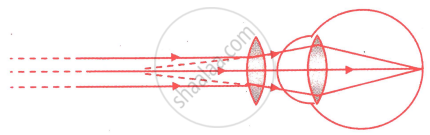
(d) In order to see an object clearly at infinity, the person should use concave lenses in his spectacles. A concave lens first diverges the light rays from the object at infinity to form a virtual image at the eye's far point. The eye lens then easily focusses the rays from the eye's far point to form a clear image on the retina.
APPEARS IN
संबंधित प्रश्न
Given below is a diagram showing a defect of human eye. Study it and answer the following questions.

(i) Name the defect shown in the figure.
(ii) Give reason for this defect of eye in human being.
(iii) Name the type of lens used to correct the eye defect.
A student is unable to see clearly the words written on the blackboard placed at a distance of approximately 4 m from him. Name the defect of vision the boy is suffering from. Explain the method of correcting this defect.
Draw ray diagram for the:-
(i) defect of vision and also
(ii) for its correction.
What is the other name for
myopia
Name the defect of vision which makes the eye-lens cloudy resulting in blurred vision.
A man can read the number of a distant bus clearly but he finds difficulty in reading a book.
- From which defect of the eye is he suffering?
- What type of spectacle lens should he use to correct the defect?
Differentiate between myopia and hypermetropia.
A person can read a book clearly only if he holds it at an arm's length from him. Name the defect of vision:
- if the person is an old man
- if the person is a young man
Which part of the eye is grafted in a needy patient from a donated eye?
Differentiate between members of the following pair with reference to what is asked in bracket.
Myopia and hyperopia (cause of the defect)
Name an old age eye defect. What happens in it?
You do not enjoy watching a movie from a very short distance from the screen in a cinema hall. Why?
A student cannot see a chart hanging on a wall placed at a distance of 3 m from him. Name the defect of vision he is suffering from. How can it be corrected? Draw ray diagrams for the (i) defect of vision and also (ii) for its correction.
List two causes of presbyopia. Draw labelled diagram of a lens used for the correction of this defect of vision.
Rewrite the following table so as to match second and third column with first column.
|
Column I
|
Column II
|
Column III
|
|
(i) Myopia
|
Old age problem
|
Bifocal lens
|
|
(ii) Presbyopia
|
Nearsightedness
|
Concave lens.
|
Complete the following sentence with appropriate word :
An inability to focus on nearby objects due to loss of elasticity of the lens with age is called Iris.
Given below is a diagrammatic representation of a defect of the human eye:

(i) Identify the defect.
(ii) Mention two reasons for the above defect.
(iii) State how the defect can be rectified.
(iv) Name the part of the eye responsible for maintaining the shape of the eyeball.
Observe the given below the figure, correct it and explain and write about the concept depicted in this figure.
A student sitting at the back of the classroom cannot read clearly the letters written on the blackboard. What advice will a doctor give to her? Draw ray diagram for the correction of this defect.
When do we consider a person to be myopic or hypermetropic? Explain using diagrams how the defects associated with myopic and hypermetropic eye can be corrected?
