Advertisements
Advertisements
Question
Describe the mechanism of focusing the image of a distant object in your eye when you raise your head after reading a book.
Advertisements
Solution 1
While reading a book, the lens is more convex or rounded due to contraction of ciliary muscles because the book is usually read from a short distance. When we raise our head and look at a distant object, the ciliary muscles relax to build the tension on the suspensory ligament so that they can stretch the lens. This change in the curvature of the lens makes us focus on distant object.


Solution 2
The lens is adjusted through accommodation to focus on a distant object while reading. This is a full description:
- Near Vision (Reading a Book):
- Reading causes ciliary muscle contractions in the eyes.
- When the ciliary muscles contract, the suspensory ligaments that support the lens slacken.
- This enables the lens to become more convex or rounded.
- Transition to Distant Vision (Raising Your Head):
- Your ciliary muscles relax when you elevate your head to focus on a distant object.
- Suspensory ligaments pull and flatten the lens.
- The ciliary muscles relax, and the suspensory ligaments strain on the lens.
- Accommodation Power of the Eye:
- Accommodation refers to the process of adjusting focus by modifying the lens shape.
- The eye's accommodation power relies heavily on the ciliary muscles.
- The eye's capacity to concentrate clearly at diverse distances is vital for adapting to various visual tasks.
The ciliary muscles alter the lens shape dynamically, making it convex for near vision and flat for distant vision. The eye's ability to focus clearly at varied distances is due to the process of accommodation.
APPEARS IN
RELATED QUESTIONS
Write the importance of ciliary muscles in the human eye. Name the defect of vision that arises due to gradual weakening of the ciliary muscles. What types of lenses are required by the person suffering from this defect to see the objects clearly?
Akshay, sitting in the last row in his class, could not see clearly the words write on the blackboard. When the teacher noticed it, he announced if any student sitting in the front row could volunteer to exchange his seat with Akshay. Salman immediately agreed to exchange his seat with Akshay. He could now see the words written on the blackboard clearly. The teacher thought it fit to send the message to Akshay’s parents advising them to get his eyesight checked.
In the context of the above event, answer the following questions:-
(a) Which defect of vision is Akshay suffering from? Which type of lens is used to correct this defect?
(b) State the values displayed by the teacher and Salman.
(c) In your opinion, in what way can Akshay express his gratitude towards the teacher and Salman?
What is Hypermetropia (far sightedness)?
Have a look at the posture of this woman who is reading a book and answer the questions which follow:

What are the two conditions shown in sections A and B of the eye as applicable to her?
The near point of the eye of a person is 50 cm. Find the nature and power of the corrective lens required by the person to enable him to see clearly the objects placed at 25 cm from the eye?
Explain the Term: Hypermetropia
The diagram given below represents the cross-section of the human eye:

(i) Name the parts labeled 1—12.
(ii) What is the function of the part marked ‘10’?
(iii) What would happen if part ‘5’ is damaged or cut?
Nearsightedness: elongated eyeball : : farsightedness: _______
Observe the given below the figure, correct it and explain and write about the concept depicted in this figure.
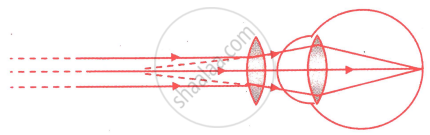
Which of the following statement is correct?
A student sitting at the back of the classroom cannot read clearly the letters written on the blackboard. What advice will a doctor give to her? Draw ray diagram for the correction of this defect.
