Advertisements
Advertisements
Question
The diagram alongside represents a section of a mammalian eye.
(i) Label the parts 1 to 5 of the diagram.
(ii) State the function of the parts labelled 4 and 5.
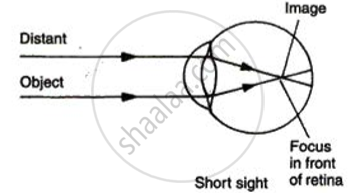
(iii) With the help of a diagram show the short sightedness.

Advertisements
Solution
(i) 1- Retina
2 - Yellow spot
3 - Blind spot
4 - Optic nerve
5 - Lens
(ii) Optic nerves - It transmits the impulses to the brain.
Lens - It focuses the image on the retina.
(iii) Short sightedness:
APPEARS IN
RELATED QUESTIONS
What is myopia?
Millions of people in the developing countries of the world are suffering from corneal blindness. These persons can be cured by replacing the defective cornea with the cornea of a donated eye. A charitable society of your city has organised a campaign in your neighbourhood in order to create awareness about this fact. If you are asked to participate in this mission, how would you contribute in this noble cause?
(i) State the objective of organising such campaigns.
(ii) List two arguments which you would give to motivate the people to donate their eyes after death.
(iii) List two values which are developed in the persons who actively participate and contribute in such programmes.
The defect of vision which cannot be corrected by using spectacles is:
(a) myopia
(b) presbyopia
(c) cataract
(d) hypermetropia
A person cannot see the distant objects clearly (though he can see the nearby objects clearly). He is suffering from the defect of vision called:
(a) cataract
(b) hypermetropia
(c) myopia
(d) presbyopia
The defect of vision in which the eye-lens of a person gets progressively cloudy resulting in blurred vision is called:
(a) myopia
(b) presbyopia
(c) colourblindness
(d) cataract
State one role of ciliary muscles in the human eye.
Name the following:
The photosensitive pigment present in the rod cells of the retina.
Choose the Odd One Out:
Due to elongation of _______ and increase in curvature of the eye lens, a person cannot see distant objects clearly.
Draw ray diagram showing myopic eye.
