Advertisements
Advertisements
Question
Though a woman can see the distant object clearly, she cannot see the nearby objects clearly. She is suffering from the defect of vision called:
(a) long-sight
(b) short-sight
(c) hind-sight
(d) mid-sight
Advertisements
Solution
long sight
As the woman can see distant objects clearly, but not nearby objects, she is suffering from the defect of vision called long sight.
APPEARS IN
RELATED QUESTIONS
What is the scientific name of
short-sightedness
Name the defect of vision which can be corrected by a diverging lens. Show clearly by a ray diagram how the lens corrects the defect.
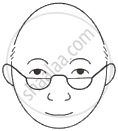
The picture given here shows a person wearing ‘half-moon’ spectacles. What sort of eye-defect do you think he has? Why are these particular spectacles useful to him?
To read a book held at a distance of 25 cm, will she need converging or diverging spectacle lenses?
Name the following:
The eye defect caused due to shortening of the eye ball from front to back.
Differentiate between members of the following pair with reference to what is asked in the bracket.
Rods and cones (sensitivity).
Draw a ray diagram to show how Hypermetropia is defect can be corrected using a lens.
Observer the following diagram and answer the questions.
a) Which eye defect is shown in this diagram?
b) What are the possible reasons for this eye defect?
c) How this defect is corrected, write it in brief?

Given alongside is a diagram depicting a defect of the human eye. Study the same and then answer the questions that follow:
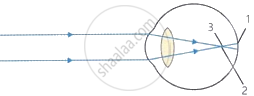
- Identify the defect.
- Name the parts labelled 1, 2 and 3.
- Give two possible reasons for this eye defect.
- Draw a labelled diagram to show how the above mentioned defect is rectified.
The near point of the eye of a person is 50 cm. Find the nature and power of the corrective lens required by the person to enable him to see clearly the objects placed at 25 cm from the eye?
Give Reason:
Deficiency of vitamin A causes night blindness.
Draw a neat labeled diagram to show how hypermetropia can be rectified.
Choose the Odd One Out:
In Myopia the human eye _______.
Observe the given below the figure, correct it and explain and write about the concept depicted in this figure.
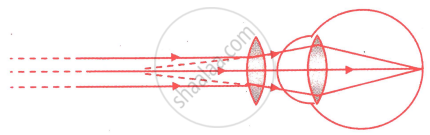
Given below is a diagram showing a defect of vision. Name the defect of vision and draw an accurately labelled diagram to correct this defect.
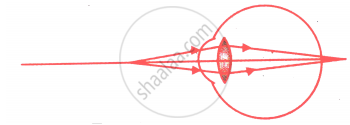
Differentiate the eye defects: Myopia and Hypermetropia
Myopia may arise due to ____________.
Which of the following statement is correct?
