Advertisements
Advertisements
Question
A young man has to hold a book at arm's length to be able to read it clearly. The defect of vision is:
(a) astigmatism
(b) myopia
(c) presbyopia
(d) hypermetropia
Advertisements
Solution
hypermetropia
Hypermetropia is the defect of vision the young man is suffering from, because of which he finds it difficult to see nearby objects.
APPEARS IN
RELATED QUESTIONS
Millions of people in the developing countries of the world are suffering from corneal blindness. These persons can be cured by replacing the defective cornea with the cornea of a donated eye. A charitable society of your city has organised a campaign in your neighbourhood in order to create awareness about this fact. If you are asked to participate in this mission, how would you contribute in this noble cause?
(i) State the objective of organising such campaigns.
(ii) List two arguments which you would give to motivate the people to donate their eyes after death.
(iii) List two values which are developed in the persons who actively participate and contribute in such programmes.
The far point of a myopic person is 80 cm in front of the eye. What is the nature and power of the lens required to correct the problem?
Name the defect of vision in which the eye-lens loses its power of accommodation due to old age.
What is the other name of old age hypermetropia?
Explain with the help of labelled ray-diagram, the defect of vision called hypermetropia, and hot it is corrected by a lens.
A person suffering from the eye-defect myopia (short-sightedness) can see clearly only up to a distance of 2 metres. What is the nature and power of lens required to rectify this defect?
What is short-sightedness? State the two causes of short-sightedness (or myopia). With the help of ray diagrams, show:
(i) the eye-defect short-sightedness.
(ii) correction of short-sightedness by using a lens.
A person can read a book clearly only if he holds it at an arm's length from him. Name the defect of vision:
if the person is a young man
Have a look at the posture of this girl who is reading a book and answer the questions which follow:

Name the problem she is facing.
A person cannot read newspaper placed nearer than 50 cm from his eyes. Name the defect of vision he is suffering from. Draw a ray diagram to illustrate this defect. List its two possible causes. Draw a ray diagram to show how this defect may be corrected using a lens of appropriate focal length.
What is Hypermetropia (far sightedness)?
Anuja cannot see the blackboard writing but she can see nearby things.
(a) What is the eye defect she is suffering from?
(b) State the possible reason for her defect.
(c) How is it corrected
Name an old age eye defect. Why is it caused?
Explain the Term: Hypermetropia
Due to elongation of _______ and increase in curvature of the eye lens, a person cannot see distant objects clearly.
What are the causes of ‘Myopia’?
Differentiate the eye defects: Myopia and Hypermetropia
State reasons for Myopia. With the help of ray diagrams, show the:
- image formation by a myopic eye, and
- correction of myopia using an appropriate lens.
Given alongside is a diagram depicting a defect of the human eye. Study the same and answer the questions that follow:
 |
- Name the defect shown in the diagram.
- Give two possible reasons for this defect.
- Name the parts labelled 1 to 4.
- Name the type of lens used to correct this eye defect.
- Draw a labelled diagram to show how the above mentioned defect is rectified using the lens named above.
Have a look at the posture of this girl who is reading a book and answer the questions which follow:
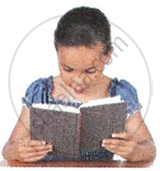 |
- Name the problem she is facing.
- What are the two conditions shown in sections A and B of the eye as applicable to her.
- What kind of reading glasses does she need?
 |
 |
| A | B |
