Advertisements
Advertisements
प्रश्न
A young man has to hold a book at arm's length to be able to read it clearly. The defect of vision is:
(a) astigmatism
(b) myopia
(c) presbyopia
(d) hypermetropia
Advertisements
उत्तर
hypermetropia
Hypermetropia is the defect of vision the young man is suffering from, because of which he finds it difficult to see nearby objects.
APPEARS IN
संबंधित प्रश्न
the biological/technical terms for the lens of eye losing flexibility resulting in a kind of long-sightedness in middle aged people.
Name the defect of vision in a person:
whose far point is less than infinity
Which defect of vision can be rectified:
by using a convex lens?
What is the other name for
hypermetropia
Name the defect of vision which makes the eye-lens cloudy resulting in blurred vision.
Explain with the help of labelled ray-diagram, the defect of vision called hypermetropia, and hot it is corrected by a lens.
The defect of vision in which the eye-lens of a person gets progressively cloudy resulting in blurred vision is called:
(a) myopia
(b) presbyopia
(c) colourblindness
(d) cataract
To read a book held at a distance of 25 cm, will she need converging or diverging spectacle lenses?
Choose the odd one out from the following terms and name the category to which the others belong.
Endolymph, Tympanic membrane, Semi-circular canal, Blind spot
Write whether the following is true or false:
A convex lens is used for correcting myopia.
The diagram alongside represents a section of a mammalian eye.
(i) Label the parts 1 to 5 of the diagram.
(ii) State the function of the parts labelled 4 and 5.
(iii) With the help of a diagram show the short sightedness.

Given below is a diagram depicting a defect of the human eye? Study the same and answer the question that follow:
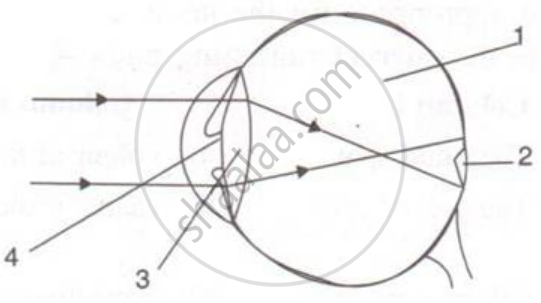
Give two possible reasons for this defect of the eye in human beings.
Given below is a diagram depicting a defect of the human eye? Study the same and answer the question that follow:

Draw a labeled diagram to show how the above mentioned defect is rectified using the lens named above.
Have a look at the posture of this woman who is reading a book and answer the questions which follow:

What are the two conditions shown in sections A and B of the eye as applicable to her?
Give Reason:
When you enter into a dark room from bright because of sunlight, you can not see things for a few seconds.
Choose the Odd One Out:
Due to elongation of _______ and increase in curvature of the eye lens, a person cannot see distant objects clearly.
Myopia may arise due to ____________.
Correlate the given sequence:
Hypermetropia : Convex lens : ______ : Concave lens
Observe the figure and answer the following questions:

- Name the defect of vision represented in the above figure.
- State the reasons for this defect.
- How is it corrected?
- Draw the diagram to show the correction of this defect.
