Advertisements
Advertisements
प्रश्न
Due to elongation of _______ and increase in curvature of the eye lens, a person cannot see distant objects clearly.
पर्याय
eyeball
pupil
eyelid
cornea
Advertisements
उत्तर
Due to elongation of eyeball and increase in curvature of the eye lens, a person cannot see distant objects clearly.
APPEARS IN
संबंधित प्रश्न
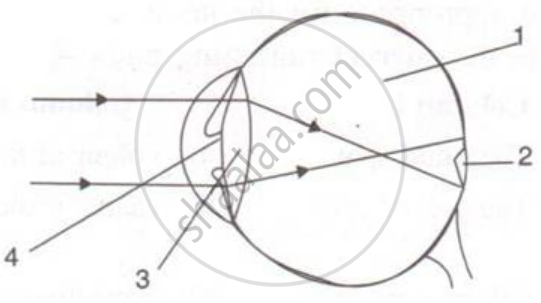
Given below is a diagram showing a defect of human eye. Study it and answer the following questions.

(i) Name the defect shown in the figure.
(ii) Give reason for this defect of eye in human being.
(iii) Name the type of lens used to correct the eye defect.
Do you know that the corneal-impairment can be cured by replacing the defective cornea with the cornea of the donated eye? How and why should we organise groups to motivate the community members to donate their eyes after death?
Explain two possible reasons of myopia. How can it be corrected? Explain with a suitable diagram.
The kind of lens required to correct Myopia
Name the defect of vision in a person:
whose far point is less than infinity
What is the scientific name of
short-sightedness
Name the defect of vision which makes the eye-lens cloudy resulting in blurred vision.
What is the far point of a person suffering from myopia (or short-sightedness)?
Where is the near point of a person suffering from hypermetropia (or long-sightedness)?
A student sitting in the last row of the class-room is not able to read clearly the writing on the blackboard.
- Name the type of defect he is suffering from.
- How can this defect by corrected?
What are the two most common defects of vision (or defects of eye)? How are they corrected?
Name the defect of vision which can be corrected by a diverging lens. Show clearly by a ray diagram how the lens corrects the defect.
A person suffering from the eye-defect myopia (short-sightedness) can see clearly only up to a distance of 2 metres. What is the nature and power of lens required to rectify this defect?
An eye has a near point distance of 0.75 m. What sort of lens in spectacles would be needed to reduce the near point distance to 0.25 m? Also calculate the power of lens required. Is this eye long-sighted or short-sighted?
A person cannot see the distant objects clearly (though he can see the nearby objects clearly). He is suffering from the defect of vision called:
(a) cataract
(b) hypermetropia
(c) myopia
(d) presbyopia
Given below is a diagram depicting a defect of the human eye. Study the same and answer the question that follow:

Name the defect shown in the diagram.
Draw a ray diagram to show how Hypermetropia is defect can be corrected using a lens.
Observer the following diagram and answer the questions.
a) Which eye defect is shown in this diagram?
b) What are the possible reasons for this eye defect?
c) How this defect is corrected, write it in brief?

When do we consider a student sitting in the class to be myopic? List two causes of this defect. Explain using a ray diagram how this defect of eye can be corrected.
Name the following:
The photosensitive pigment present in the rod cells of the retina.
Distinguish between the following pair of words:
Myopia and hypermetropia
The diagram alongside represents a section of a mammalian eye.
(i) Label the parts 1 to 5 of the diagram.
(ii) State the function of the parts labelled 4 and 5.
(iii) With the help of a diagram show the short sightedness.

Choose the correct answer :
Presbyopia is a disease of _____________
Given below is a diagram depicting a defect of the human eye? Study the same and answer the question that follow:
Give two possible reasons for this defect of the eye in human beings.
The near point of the eye of a person is 50 cm. Find the nature and power of the corrective lens required by the person to enable him to see clearly the objects placed at 25 cm from the eye?
Give Reason:
Why do we see clearly in the central region of the retina?
Differentiate between:
Short-sightedness and Long-sightedness.
Draw a neat labeled diagram to show how hypermetropia can be rectified.
Give Technical Term:
The type of lens used to correct myopia is
Nearsightedness: elongated eyeball : : farsightedness: _______
Differentiate the eye defects: Myopia and Hypermetropia
Assertion: Myopia is the defect of vision in which a person cannot see distant objects clearly.
Reason: This due to eye-ball being too short.
Correlate the given sequence:
Hypermetropia : Convex lens : ______ : Concave lens
Complete the following table by observing the given figures:
| Figure → |  |
 |
| Points ↓ | ||
| (a) Name of the defect | ______ | ______ |
| (b) Position of the image | ______ | ______ |
| (c) Lens used to correct the defect | ______ | ______ |
A teacher drew the diagram of the heart on the blackboard and told the students to copy it in their notebooks. Mahesh couldn't see the diagram clearly as it appeared blurred to him.
- Name the defect of the eye Mahesh is suffering from.
- Where is the image formed in this defect?
- Mahesh consults an eye doctor and is prescribed suitable lenses to correct the defect. Which type of lens do his spectacles have?
Name the following:
Two kinds of accomodations.
