Advertisements
Advertisements
प्रश्न
In Myopia the human eye _______.
पर्याय
cannot see nearby objects distinctly
cannot see distant objects clearly
cannot see nearby as well as distant objects clearly
can see nearby as well as distant objects clearly
Advertisements
उत्तर
In Myopia the human eye cannot see distant objects clearly.
संबंधित प्रश्न
Given below is a diagram showing a defect of human eye. Study it and answer the following questions.

(i) Name the defect shown in the figure.
(ii) Give reason for this defect of eye in human being.
(iii) Name the type of lens used to correct the eye defect.
What is myopia?
Write the importance of ciliary muscles in the human eye. Name the defect of vision that arises due to gradual weakening of the ciliary muscles. What types of lenses are required by the person suffering from this defect to see the objects clearly?
Akshay, sitting in the last row in his class, could not see clearly the words write on the blackboard. When the teacher noticed it, he announced if any student sitting in the front row could volunteer to exchange his seat with Akshay. Salman immediately agreed to exchange his seat with Akshay. He could now see the words written on the blackboard clearly. The teacher thought it fit to send the message to Akshay’s parents advising them to get his eyesight checked.
In the context of the above event, answer the following questions:-
(a) Which defect of vision is Akshay suffering from? Which type of lens is used to correct this defect?
(b) State the values displayed by the teacher and Salman.
(c) In your opinion, in what way can Akshay express his gratitude towards the teacher and Salman?
About 45 lac people in the developing countries are suffering from corneal blindness. About 30 lac children below the age of 12 years suffering from this defect can be cured by replacing the defective cornea with the cornea of a donated eye. How and why can students of your age involve themselves to create awareness about this fact among people?
The far point of a myopic person is 80 cm in front of the eye. What is the nature and power of the lens required to correct the problem?
Which defect of vision can be rectified:
by using a concave lens?
Name the body part with which the terms myopia and hypermetropia are connected.
A man can read the number of a distant but clearly but he finds difficulty in reading a book.
What type of spectacle lens should he use to correct the defect?
A student sitting in the last row of the class-room is not able to read clearly the writing on the blackboard.
- Name the type of defect he is suffering from.
- How can this defect by corrected?
Name the defect of vision which can be corrected by a converging lens. Show clearly by a ray diagram how the lens corrects the defect.
Name the defect of vision which can be corrected by a diverging lens. Show clearly by a ray diagram how the lens corrects the defect.
A person suffering from the eye-defect myopia (short-sightedness) can see clearly only up to a distance of 2 metres. What is the nature and power of lens required to rectify this defect?
An eye has a near point distance of 0.75 m. What sort of lens in spectacles would be needed to reduce the near point distance to 0.25 m? Also calculate the power of lens required. Is this eye long-sighted or short-sighted?
A person cannot see the distant objects clearly (though he can see the nearby objects clearly). He is suffering from the defect of vision called:
(a) cataract
(b) hypermetropia
(c) myopia
(d) presbyopia
A person can read a book clearly only if he holds it at an arm's length from him. Name the defect of vision:
if the person is a young man
Which part of the eye is grafted in a needy patient from a donated eye?
Have a look at the posture of this girl who is reading a book and answer the questions which follow:

Name the problem she is facing.
An old man cannot see objects closer than 1 m from the eye clearly. Name the defect of vision he is suffering from. How can it be corrected? Draw ray diagram for the (i) defect of vision and also (ii) for its correction.
What eye defect is hypermetropia? Describe with a ray diagram how this defect of vision can be corrected by using an appropriate lens.
When do we consider a student sitting in the class to be myopic? List two causes of this defect. Explain using a ray diagram how this defect of eye can be corrected.
Choose the odd one out from the following terms and name the category to which the others belong.
Endolymph, Tympanic membrane, Semi-circular canal, Blind spot
Have a look at the posture of this woman who is reading a book and answer the questions which follow:

What are the two conditions shown in sections A and B of the eye as applicable to her?
The near point of the eye of a person is 50 cm. Find the nature and power of the corrective lens required by the person to enable him to see clearly the objects placed at 25 cm from the eye?
In what two whys is a yellow spot different from the blind spot?
Give Reason:
Why do we see clearly in the central region of the retina?
Give Reason:
When you enter into a dark room from bright because of sunlight, you can not see things for a few seconds.
Differentiate between:
Short-sightedness and Long-sightedness.
Explain the Term: Presbyopia
Name the following:
The defect of the human eye caused due to the uneven surface of the cornea.
Write scientific reason.
Nearsightedness, this defect can be corrected by using spectacles with concave lens.
Observe the given below the figure, correct it and explain and write about the concept depicted in this figure.
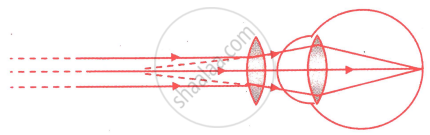
Given below is a diagram showing a defect of vision. Name the defect of vision and draw an accurately labelled diagram to correct this defect.
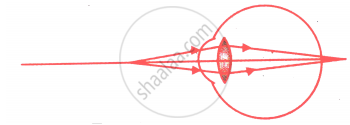
Which of the following statement is correct?
Which of the following statement is correct?
When do we consider a person to be myopic or hypermetropic? Explain using diagrams how the defects associated with myopic and hypermetropic eye can be corrected?
Observe the following diagram and answer questions following it:

- Identify the defect of vision shown.
- List its two causes.
- Name the type of lens used for the correction of this defect.
Have a look at the posture of this girl who is reading a book and answer the questions which follow:
 |
- Name the problem she is facing.
- What are the two conditions shown in sections A and B of the eye as applicable to her.
- What kind of reading glasses does she need?
 |
 |
| A | B |
