Advertisements
Advertisements
प्रश्न
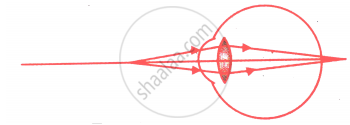
Given below is a diagram showing a defect of vision. Name the defect of vision and draw an accurately labelled diagram to correct this defect.
Advertisements
उत्तर
Name of defect: Farsightedness or hypermetropia
Correction of Farsightedness:

APPEARS IN
संबंधित प्रश्न
Given below is a diagram showing a defect of human eye. Study it and answer the following questions.

(i) Name the defect shown in the figure.
(ii) Give reason for this defect of eye in human being.
(iii) Name the type of lens used to correct the eye defect.
List three common refractive defects of vision. Suggest the way of correcting these defects.
About 45 lac people in the developing countries are suffering from corneal blindness. About 30 lac children below the age of 12 years suffering from this defect can be cured by replacing the defective cornea with the cornea of a donated eye. How and why can students of your age involve themselves to create awareness about this fact among people?
What is the far point and near point of the human eye with normal vision?
A student suffering from myopia is not able to see distinctly the objects placed beyond 5 m. List two possible reasons due to which this defect of vision may have arisen. With the help of ray diagrams, explain
(i) why the student is unable to see distinctly the objects placed beyond 5 m from his eyes.
(ii) the type of the corrective lens used to restore proper vision and how this defect is corrected by the use of this lens.
(b) If, in this case, the numerical value of the focal length of the corrective lens is 5 m, find the power of the lens as per the new Cartesian sign convention
the biological/technical terms for the lens of eye losing flexibility resulting in a kind of long-sightedness in middle aged people.
Name the defect of vision which makes the eye-lens cloudy resulting in blurred vision.
What is the other name of old age hypermetropia?
A man can read the number of a distant bus clearly but he finds difficulty in reading a book.
- From which defect of the eye is he suffering?
- What type of spectacle lens should he use to correct the defect?
A student sitting in the last row of the class-room is not able to read clearly the writing on the blackboard.
- Name the type of defect he is suffering from.
- How can this defect by corrected?
A person cannot see the distant objects clearly (though he can see the nearby objects clearly). He is suffering from the defect of vision called:
(a) cataract
(b) hypermetropia
(c) myopia
(d) presbyopia
A young man has to hold a book at arm's length to be able to read it clearly. The defect of vision is:
(a) astigmatism
(b) myopia
(c) presbyopia
(d) hypermetropia
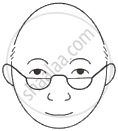
The picture given here shows a person wearing ‘half-moon’ spectacles. What sort of eye-defect do you think he has? Why are these particular spectacles useful to him?
Name the following:
The eye defect caused due to shortening of the eye ball from front to back.
Name an old age eye defect. What happens in it?
Describe the mechanism of focusing the image of a distant object in your eye when you raise your head after reading a book.
Explain the terms ‘adaptation’ and ‘accommodation’ with reference to the eye.
A student cannot see a chart hanging on a wall placed at a distance of 3 m from him. Name the defect of vision he is suffering from. How can it be corrected? Draw ray diagrams for the (i) defect of vision and also (ii) for its correction.
List two causes of presbyopia. Draw labelled diagram of a lens used for the correction of this defect of vision.
Name the following:
The photosensitive pigment present in the rod cells of the retina.
Given below is a diagram depicting a defect of the human eye? Study the same and answer the question that follow:
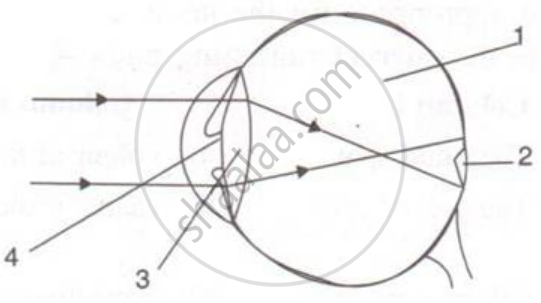
Give two possible reasons for this defect of the eye in human beings.
The near point of the eye of a person is 50 cm. Find the nature and power of the corrective lens required by the person to enable him to see clearly the objects placed at 25 cm from the eye?
A person is unable to see objects distinctly placed within 50 cm from his eyes.
(a) Name the defect of vision the person is suffering from and list its two possible causes.
(b) Draw a ray diagram to show the defect in the above case.
(c) Mention the type of lens used by him for the correction of the defect and calculate its power. Assume that the near point for the normal eye is 25 cm.
(d) Draw a labeled diagram for the correction of the defect in the above case.
In what two whys is a yellow spot different from the blind spot?
Explain the Term: Hypermetropia
Explain the Term: Astigmatism
Complete the following sentence with appropriate word :
An inability to focus on nearby objects due to loss of elasticity of the lens with age is called Iris.
Study the following diagram carefully and then answer the questions that follow. The diagram is depicting a defect of the human eye :

(i) Identify the defect shown in the diagram.
(ii) Give two possible reasons for the above defect.
What are the causes of ‘Myopia’?
Myopia and hypermetropia can be corrected by:
Assertion: Concave mirrors are used as reflectors in torches, vehicle head lights and in search lights.
Reason: When an object is placed beyond the center of curvature of a concave mirror, the image formed is real and inverted.
Which of the following statement is correct?
Draw ray diagram showing myopic eye.
A person needs a lens of power –4.5 D for correction of her vision.
- What kind of defect in vision is she suffering from?
- What is the focal length of the corrective lens?
- What is the nature of the corrective lens?
A teacher drew the diagram of the heart on the blackboard and told the students to copy it in their notebooks. Mahesh couldn't see the diagram clearly as it appeared blurred to him.
- Name the defect of the eye Mahesh is suffering from.
- Where is the image formed in this defect?
- Mahesh consults an eye doctor and is prescribed suitable lenses to correct the defect. Which type of lens do his spectacles have?
Have a look at the posture of this girl who is reading a book and answer the questions which follow:
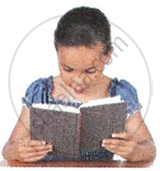 |
- Name the problem she is facing.
- What are the two conditions shown in sections A and B of the eye as applicable to her.
- What kind of reading glasses does she need?
 |
 |
| A | B |
