Advertisements
Advertisements
प्रश्न
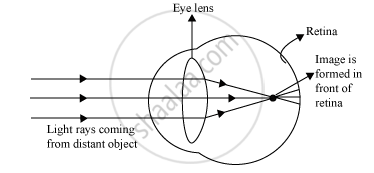
A student cannot see a chart hanging on a wall placed at a distance of 3 m from him. Name the defect of vision he is suffering from. How can it be corrected? Draw ray diagrams for the (i) defect of vision and also (ii) for its correction.
Advertisements
उत्तर
The defect of vision is myopia. It can be corrected by using a concave lens of suitable power. Following are the ray diagrams:
(i) Defect of vision.
(ii) For its correction.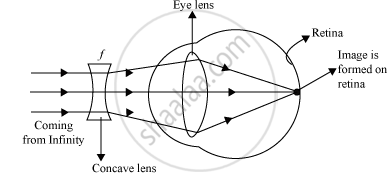
संबंधित प्रश्न
A student is unable to see clearly the words written on the black board placed at a distance of approximately 3 m from him. Name the defect of vision the boy is suffering from. State the possible causes of this defect and explain the method of correcting it.
Which defect of vision can be rectified:
by using a concave lens?
What is the other name of old age hypermetropia?
A man can read the number of a distant but clearly but he finds difficulty in reading a book.
What type of spectacle lens should he use to correct the defect?
The defect of vision which cannot be corrected by using spectacles is:
(a) myopia
(b) presbyopia
(c) cataract
(d) hypermetropia
By closing the eyes and gently pressing them by your palms, you may see some specks of brilliant light. How do you get this sensation while there is no light entering your eyes?
When do we consider a student sitting in the class to be myopic? List two causes of this defect. Explain using a ray diagram how this defect of eye can be corrected.
What type of lens is used to correct Astigmatism?
Due to elongation of _______ and increase in curvature of the eye lens, a person cannot see distant objects clearly.
Observe the figure whether it is correct or not and explain the phenomenon.

