Advertisements
Advertisements
प्रश्न
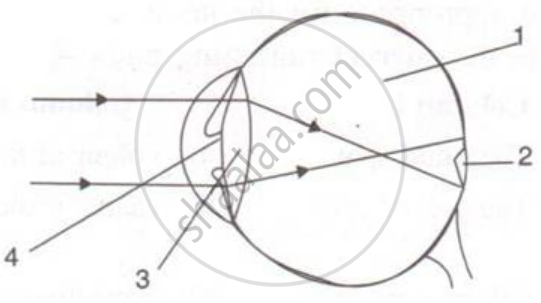
Study the following diagram carefully and then answer the questions that follow. The diagram is depicting a defect of the human eye :

(i) Identify the defect shown in the diagram.
(ii) Give two possible reasons for the above defect.
Advertisements
उत्तर
(i) Farsightedness or hypermetropia.
(ii)
(a) The lens is flattened or less convex,
(b) Eyeball is short.
संबंधित प्रश्न
What is myopia?
What is the other name for
myopia
Name the defect of vision which can be corrected by a converging lens. Show clearly by a ray diagram how the lens corrects the defect.
Explain with the help of labelled ray diagram, the defect of vision called myopia and how it is corrected by a lens.
A short-sighted person has a near point of 15 cm and a far point of 40 cm.
(a) Can he see clearly an object at a distance of:
(i) 5 cm?
(ii) 25 cm?
(iii) 50 cm?
(b) To see clearly an object at infinity, what kind of spectacle lenses does he need?
To read a book held at a distance of 25 cm, will she need converging or diverging spectacle lenses?
Given below is a diagram depicting a defect of the human eye? Study the same and answer the question that follow:
Give two possible reasons for this defect of the eye in human beings.
Name the following:
The defect of the human eye caused due to the uneven surface of the cornea.
Assertion: Concave mirrors are used as reflectors in torches, vehicle head lights and in search lights.
Reason: When an object is placed beyond the center of curvature of a concave mirror, the image formed is real and inverted.
A person needs a lens of power –4.5 D for correction of her vision.
- What kind of defect in vision is she suffering from?
- What is the focal length of the corrective lens?
- What is the nature of the corrective lens?
