Advertisements
Advertisements
प्रश्न
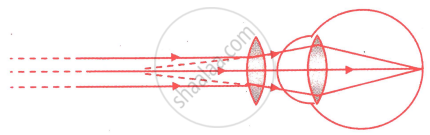
List three common refractive defects of vision. Suggest the way of correcting these defects.
Advertisements
उत्तर
The three common refractive defects of vision are as follows:-
Myopia (short-sightedness):- It is corrected by using spectacles having concave lenses of appropriate power.
Hypermetropia (far-sightedness):- It is corrected by using spectacles having convex lenses of appropriate power.
Presbyopia:- This defect is corrected using bifocal lenses of appropriate power in which the upper part consists of a concave lens (to correct myopia) and the lower part consists of a convex lens (to correct hypermetropia).
APPEARS IN
संबंधित प्रश्न
the biological/technical terms for the lens of eye losing flexibility resulting in a kind of long-sightedness in middle aged people.
Name the defect of vision which can be corrected by a diverging lens. Show clearly by a ray diagram how the lens corrects the defect.
A person suffering from the eye-defect myopia (short-sightedness) can see clearly only up to a distance of 2 metres. What is the nature and power of lens required to rectify this defect?
A young man has to hold a book at arm's length to be able to read it clearly. The defect of vision is:
(a) astigmatism
(b) myopia
(c) presbyopia
(d) hypermetropia
The defect of vision in which the eye-lens of a person gets progressively cloudy resulting in blurred vision is called:
(a) myopia
(b) presbyopia
(c) colourblindness
(d) cataract
Which part of the eye is grafted in a needy patient from a donated eye?
Write whether the following is true or false:
A convex lens is used for correcting myopia.
Give Reason:
Deficiency of vitamin A causes night blindness.
Observe the given below the figure, correct it and explain and write about the concept depicted in this figure.