Advertisements
Advertisements
Question
List three common refractive defects of vision. Suggest the way of correcting these defects.
Advertisements
Solution
The three common refractive defects of vision are as follows:-
Myopia (short-sightedness):- It is corrected by using spectacles having concave lenses of appropriate power.
Hypermetropia (far-sightedness):- It is corrected by using spectacles having convex lenses of appropriate power.
Presbyopia:- This defect is corrected using bifocal lenses of appropriate power in which the upper part consists of a concave lens (to correct myopia) and the lower part consists of a convex lens (to correct hypermetropia).
APPEARS IN
RELATED QUESTIONS
What are the two most common defects of vision (or defects of eye)? How are they corrected?
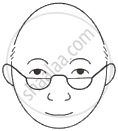
The picture given here shows a person wearing ‘half-moon’ spectacles. What sort of eye-defect do you think he has? Why are these particular spectacles useful to him?
Differentiate between members of the following pair with reference to what is asked in the bracket.
Rods and cones (sensitivity).
You do not enjoy watching a movie from a very short distance from the screen in a cinema hall. Why?
A person is unable to read a book placed closer than 1 meter from his eyes. Identify the defect of vision in his eyes. Draw the ray diagrams to show the defect of vision and its correction.
The near point of the eye of a person is 50 cm. Find the nature and power of the corrective lens required by the person to enable him to see clearly the objects placed at 25 cm from the eye?
Give Reason:
When you enter into a dark room from bright because of sunlight, you can not see things for a few seconds.
Explain the Term: Presbyopia
A person is unable to see clearly a poster fixed on a distant wall. He however sees it clearly when standing at a distance of about 2 m from the wall.
- Draw ray diagram to show the formation of image by his eye lens when he is far away from the wall.
- List two possible reasons of this defect of vision.
- Draw ray diagram to show the correction of this defect using appropriate lens.
A teacher drew the diagram of the heart on the blackboard and told the students to copy it in their notebooks. Mahesh couldn't see the diagram clearly as it appeared blurred to him.
- Name the defect of the eye Mahesh is suffering from.
- Where is the image formed in this defect?
- Mahesh consults an eye doctor and is prescribed suitable lenses to correct the defect. Which type of lens do his spectacles have?
