Advertisements
Advertisements
Question
What is the scientific name of
long-sightedness?
Advertisements
Solution
Hypermetropia is the scientific name of long-sightedness.
APPEARS IN
RELATED QUESTIONS
Do you know that the corneal-impairment can be cured by replacing the defective cornea with the cornea of the donated eye? How and why should we organise groups to motivate the community members to donate their eyes after death?
A student is unable to see clearly the words written on the blackboard placed at a distance of approximately 4 m from him. Name the defect of vision the boy is suffering from. Explain the method of correcting this defect.
Draw ray diagram for the:-
(i) defect of vision and also
(ii) for its correction.
The kind of lens required to correct Myopia
Name the defect of vision in which the eye-lens loses its power of accommodation due to old age.
What is the far point of a person suffering from myopia (or short-sightedness)?
Your friend can read a book perfectly well but cannot read the writing on blackboard unless she sits on the front row in class.
What type of lenses-converging or diverging-would an optician prescribe for her?
Name the defect of vision which can be corrected by a diverging lens. Show clearly by a ray diagram how the lens corrects the defect.
Explain with the help of labelled ray-diagram, the defect of vision called hypermetropia, and hot it is corrected by a lens.
A person suffering from the eye-defect myopia (short-sightedness) can see clearly only up to a distance of 2 metres. What is the nature and power of lens required to rectify this defect?
The near-point of a person suffering from hypermetropia is at 50 cm from his eye. What is the nature and power of the lens needed to correct this defect? (Assume that the near-point of the normal eye is 25 cm).
The defect of vision in which the eye-lens of a person gets progressively cloudy resulting in blurred vision is called:
(a) myopia
(b) presbyopia
(c) colourblindness
(d) cataract
Explain the terms ‘adaptation’ and ‘accommodation’ with reference to the eye.
Given below is a diagram depicting a defect of the human eye? Study the same and answer the question that follow:
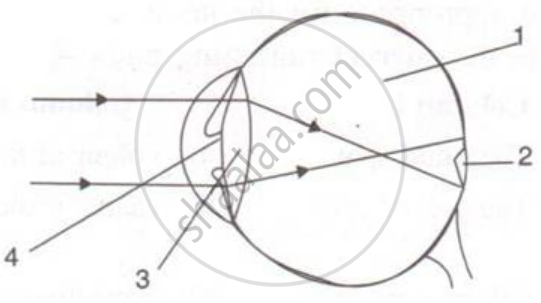
Give two possible reasons for this defect of the eye in human beings.
Given below is a diagram depicting a defect of the human eye? Study the same and answer the question that follow:

Name the parts labeled 1 to 4.
Given below is a diagram depicting a defect of the human eye? Study the same and answer the question that follow :
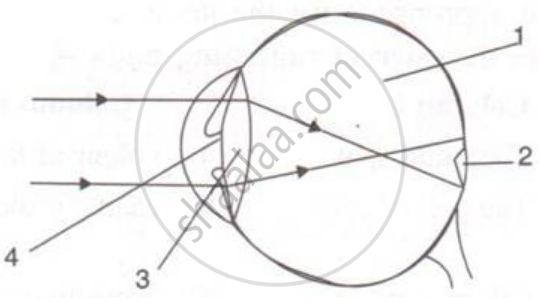
Name the type of lens used to correct this eye defect.
In Myopia the human eye _______.
Due to elongation of _______ and increase in curvature of the eye lens, a person cannot see distant objects clearly.
What are the causes of ‘Myopia’?
Myopia may arise due to ____________.
Correlate the given sequence:
Hypermetropia : Convex lens : ______ : Concave lens
