Advertisements
Advertisements
Question
Your friend can read a book perfectly well but cannot read the writing on blackboard unless she sits on the front row in class.
What type of lenses-converging or diverging-would an optician prescribe for her?
Advertisements
Solution
An optician would prescribe diverging lenses to correct her defect.
RELATED QUESTIONS
Name the defect of vision in a person:
whose near point is more than 25 on away.
Name the defect of vision which makes the eye-lens cloudy resulting in blurred vision.
What is the other name of old age hypermetropia?
Name any two defects of vision which can be corrected by using spectacles.
Your friend can read a book perfectly well but cannot read the writing on blackboard unless she sits on the front row in class.
- Is she short-sighted or long-sighted?
- What type of lenses-converging or diverging-would an optician prescribe for her?
Explain with the help of labelled ray diagram, the defect of vision called myopia and how it is corrected by a lens.
Name the following:
The photosensitive pigment present in the rods of the retina.
By closing the eyes and gently pressing them by your palms, you may see some specks of brilliant light. How do you get this sensation while there is no light entering your eyes?
Explain the terms ‘adaptation’ and ‘accommodation’ with reference to the eye.
A person is unable to read a book placed closer than 1 meter from his eyes. Identify the defect of vision in his eyes. Draw the ray diagrams to show the defect of vision and its correction.
When do we consider a student sitting in the class to be myopic? List two causes of this defect. Explain using a ray diagram how this defect of eye can be corrected.
Write whether the following is true or false:
A convex lens is used for correcting myopia.
Given alongside is a diagram depicting a defect of the human eye. Study the same and then answer the questions that follow:
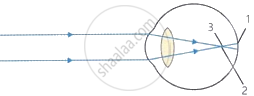
- Identify the defect.
- Name the parts labelled 1, 2 and 3.
- Give two possible reasons for this eye defect.
- Draw a labelled diagram to show how the above mentioned defect is rectified.
Given below is a diagram depicting a defect of the human eye? Study the same and answer the question that follow:
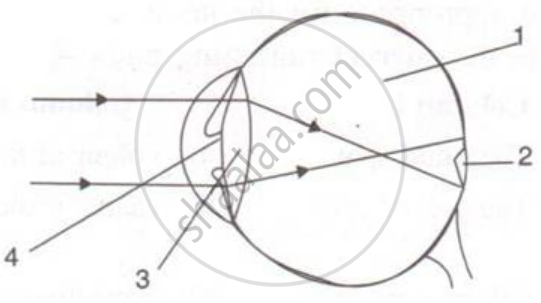
Give two possible reasons for this defect of the eye in human beings.
In what two whys is a yellow spot different from the blind spot?
Explain the Term: Cataract
Due to elongation of _______ and increase in curvature of the eye lens, a person cannot see distant objects clearly.
Correlate the given sequence:
Hypermetropia : Convex lens : ______ : Concave lens
Observe the figure and answer the following questions:

- Name the defect of vision represented in the above figure.
- State the reasons for this defect.
- How is it corrected?
- Draw the diagram to show the correction of this defect.
Match the following:
| Column - I | Column - II |
| 1. Retina | a. Path way of light |
| 2. Pupil | b. Far point comes closer |
| 3. Ciliary muscles | c. near point moves away |
| 4. Myopia | d. Screen of the eye |
| 5. Hypermetropia | e. Power of accommodation |
