Advertisements
Advertisements
Question
What is the scientific name of
short-sightedness
Advertisements
Solution
Myopia is the scientific name of short-sightedness.
APPEARS IN
RELATED QUESTIONS
Write the importance of ciliary muscles in the human eye. Name the defect of vision that arises due to gradual weakening of the ciliary muscles. What types of lenses are required by the person suffering from this defect to see the objects clearly?
Akshay, sitting in the last row in his class, could not see clearly the words write on the blackboard. When the teacher noticed it, he announced if any student sitting in the front row could volunteer to exchange his seat with Akshay. Salman immediately agreed to exchange his seat with Akshay. He could now see the words written on the blackboard clearly. The teacher thought it fit to send the message to Akshay’s parents advising them to get his eyesight checked.
In the context of the above event, answer the following questions:-
(a) Which defect of vision is Akshay suffering from? Which type of lens is used to correct this defect?
(b) State the values displayed by the teacher and Salman.
(c) In your opinion, in what way can Akshay express his gratitude towards the teacher and Salman?
A person with a myopic eye cannot see objects beyond 1.2 m distinctly. What should be the type of the corrective lens used to restore proper vision?
Which defect of vision can be rectified:
by using a convex lens?
Name any two defects of vision which can be corrected by using spectacles.
Your friend can read a book perfectly well but cannot read the writing on blackboard unless she sits on the front row in class.
- Is she short-sighted or long-sighted?
- What type of lenses-converging or diverging-would an optician prescribe for her?
The near point of a long-sighted person is 50 cm from the eye.
- Can she see clearly an object at:
- a distance of 20 cm?
- at infinity?
- To read a book held at a distance of 25 cm, will she need converging or diverging spectacle lenses?
To read a book held at a distance of 25 cm, will she need converging or diverging spectacle lenses?
Name the following:
The eye defect caused due to shortening of the eye ball from front to back.
Differentiate between members of the following pair with reference to what is asked in bracket.
Myopia and hyperopia (cause of the defect)
Draw a ray diagram to show how Hypermetropia is defect can be corrected using a lens.
A student has difficulty reading the blackboard while sitting in the last row. What could be the defect the child is suffering from? How can it be corrected?
List two causes of presbyopia. Draw labelled diagram of a lens used for the correction of this defect of vision.
Name the following:
The photosensitive pigment present in the rod cells of the retina.
Given below is a diagram depicting a defect of the human eye? Study the same and answer the question that follow:
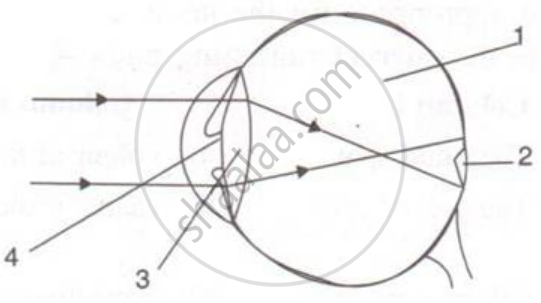
Give two possible reasons for this defect of the eye in human beings.
The near point of the eye of a person is 50 cm. Find the nature and power of the corrective lens required by the person to enable him to see clearly the objects placed at 25 cm from the eye?
In what two whys is a yellow spot different from the blind spot?
Explain the Term: Cataract
Name the following:
The defect of the human eye caused due to the uneven surface of the cornea.
A person cannot see distinctly objects kept beyond 2 m. This defect can be corrected by using a lens of power:
Observe the figure and answer the following questions:

- Name the defect of vision represented in the above figure.
- State the reasons for this defect.
- How is it corrected?
- Draw the diagram to show the correction of this defect.
