Advertisements
Advertisements
Question
A person with a myopic eye cannot see objects beyond 1.2 m distinctly. What should be the type of the corrective lens used to restore proper vision?
Advertisements
Solution 1
A person with a myopic eye should use a concave lens of focal length 1.2 m so as to restore proper vision.
Solution 2
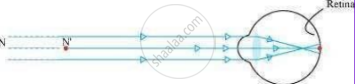
The person is able to see nearby objects clearly, but he is unable to see objects beyond 1.2 m. This happens because the image of an object beyond 1.2 m is formed in front of the retina and not at the retina, as shown in the given figure.
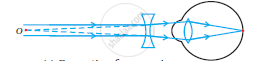
To correct this defect of vision, he must use a concave lens. The concave lens will bring the image back to the retina as shown in the given figure.
APPEARS IN
RELATED QUESTIONS
Do you know that the corneal-impairment can be cured by replacing the defective cornea with the cornea of the donated eye? How and why should we organise groups to motivate the community members to donate their eyes after death?
What is the other name for
hypermetropia
Your friend can read a book perfectly well but cannot read the writing on blackboard unless she sits on the front row in class.
What type of lenses-converging or diverging-would an optician prescribe for her?
Name the defect of vision which can be corrected by a converging lens. Show clearly by a ray diagram how the lens corrects the defect.
Explain with the help of labelled ray-diagram, the defect of vision called hypermetropia, and hot it is corrected by a lens.
The defect of vision in which the eye-lens of a person gets progressively cloudy resulting in blurred vision is called:
(a) myopia
(b) presbyopia
(c) colourblindness
(d) cataract
A person is unable to read a book placed closer than 1 meter from his eyes. Identify the defect of vision in his eyes. Draw the ray diagrams to show the defect of vision and its correction.
An old man cannot see objects closer than 1 m from the eye clearly. Name the defect of vision he is suffering from. How can it be corrected? Draw ray diagram for the (i) defect of vision and also (ii) for its correction.
The diagram alongside represents a section of a mammalian eye.
(i) Label the parts 1 to 5 of the diagram.
(ii) State the function of the parts labelled 4 and 5.
(iii) With the help of a diagram show the short sightedness.

Choose the correct answer :
Presbyopia is a disease of _____________
Have a look at the posture of this woman who is reading a book and answer the questions which follow:

What kind of looking glasses she needs?
Rewrite the following table so as to match second and third column with first column.
|
Column I
|
Column II
|
Column III
|
|
(i) Myopia
|
Old age problem
|
Bifocal lens
|
|
(ii) Presbyopia
|
Nearsightedness
|
Concave lens.
|
A person is unable to see objects distinctly placed within 50 cm from his eyes.
(a) Name the defect of vision the person is suffering from and list its two possible causes.
(b) Draw a ray diagram to show the defect in the above case.
(c) Mention the type of lens used by him for the correction of the defect and calculate its power. Assume that the near point for the normal eye is 25 cm.
(d) Draw a labeled diagram for the correction of the defect in the above case.
Name an old age eye defect. Why is it caused?
Give Reason:
Deficiency of vitamin A causes night blindness.
Draw a neat labeled diagram to show how hypermetropia can be rectified.
With respect to human eye explain:
(i) How is the image formed on the retina?
(ii) How is the amount of light entering the eye-controlled?
(iii) What type of lens is used for the correction of ‘Long sight’ defect?
(iv) With the help of a ray, diagram show the defect of the eye and then its correction after the use of a lens.
Nearsightedness : concave lens : : farsightedness : _______
