Advertisements
Advertisements
प्रश्न
A person with a myopic eye cannot see objects beyond 1.2 m distinctly. What should be the type of the corrective lens used to restore proper vision?
Advertisements
उत्तर १
A person with a myopic eye should use a concave lens of focal length 1.2 m so as to restore proper vision.
उत्तर २
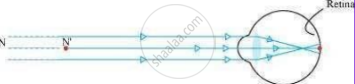
The person is able to see nearby objects clearly, but he is unable to see objects beyond 1.2 m. This happens because the image of an object beyond 1.2 m is formed in front of the retina and not at the retina, as shown in the given figure.
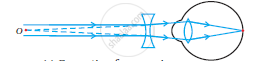
To correct this defect of vision, he must use a concave lens. The concave lens will bring the image back to the retina as shown in the given figure.
APPEARS IN
संबंधित प्रश्न
Given below is a diagram showing a defect of human eye. Study it and answer the following questions.

(i) Name the defect shown in the figure.
(ii) Give reason for this defect of eye in human being.
(iii) Name the type of lens used to correct the eye defect.
Name the defect of vision in a person:
whose near point is more than 25 on away.
Where is the near point of a person suffering from hypermetropia (or long-sightedness)?
A man can read the number of a distant bus clearly but he finds difficulty in reading a book.
- From which defect of the eye is he suffering?
- What type of spectacle lens should he use to correct the defect?
A person cannot see the distant objects clearly (though he can see the nearby objects clearly). He is suffering from the defect of vision called:
(a) cataract
(b) hypermetropia
(c) myopia
(d) presbyopia
The near point of a long-sighted person is 50 cm from the eye.
- Can she see clearly an object at:
- a distance of 20 cm?
- at infinity?
- To read a book held at a distance of 25 cm, will she need converging or diverging spectacle lenses?
A person can read a book clearly only if he holds it at an arm's length from him. Name the defect of vision:
if the person is a young man
What is Hypermetropia (far sightedness)?
The diagram alongside represents a section of a mammalian eye.
(i) Label the parts 1 to 5 of the diagram.
(ii) State the function of the parts labelled 4 and 5.
(iii) With the help of a diagram show the short sightedness.

Have a look at the posture of this woman who is reading a book and answer the questions which follow:

What are the two conditions shown in sections A and B of the eye as applicable to her?
Anuja cannot see the blackboard writing but she can see nearby things.
(a) What is the eye defect she is suffering from?
(b) State the possible reason for her defect.
(c) How is it corrected
What type of lens is used to correct Astigmatism?
With respect to human eye explain:
(i) How is the image formed on the retina?
(ii) How is the amount of light entering the eye-controlled?
(iii) What type of lens is used for the correction of ‘Long sight’ defect?
(iv) With the help of a ray, diagram show the defect of the eye and then its correction after the use of a lens.
Choose the Odd One Out:
Nearsightedness : concave lens : : farsightedness : _______
Assertion: Concave mirrors are used as reflectors in torches, vehicle head lights and in search lights.
Reason: When an object is placed beyond the center of curvature of a concave mirror, the image formed is real and inverted.
Match the following:
| Column - I | Column - II |
| 1. Retina | a. Path way of light |
| 2. Pupil | b. Far point comes closer |
| 3. Ciliary muscles | c. near point moves away |
| 4. Myopia | d. Screen of the eye |
| 5. Hypermetropia | e. Power of accommodation |
Have a look at the posture of this girl who is reading a book and answer the questions which follow:
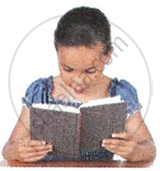 |
- Name the problem she is facing.
- What are the two conditions shown in sections A and B of the eye as applicable to her.
- What kind of reading glasses does she need?
 |
 |
| A | B |
