Advertisements
Advertisements
प्रश्न
Have a look at the posture of this girl who is reading a book and answer the questions which follow:
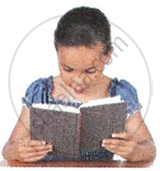 |
- Name the problem she is facing.
- What are the two conditions shown in sections A and B of the eye as applicable to her.
- What kind of reading glasses does she need?
 |
 |
| A | B |
Advertisements
उत्तर
- Myopia
- Section A depicts hyperopia, which occurs when the picture forms behind the retina. Section Bis depicts myopia, a condition where the picture forms before the retina.
- She requires reading glasses with a concave lens.
APPEARS IN
संबंधित प्रश्न
A person with a myopic eye cannot see objects beyond 1.2 m distinctly. What should be the type of the corrective lens used to restore proper vision?
What is the other name for
myopia
Name the defect of vision in which the eye-lens loses its power of accommodation due to old age.
Explain with the help of labelled ray-diagram, the defect of vision called hypermetropia, and hot it is corrected by a lens.
What is long-sightedness? State the two causes of long-sightedness (or hypermetropia). With the help of ray diagrams, show:
(i) the eye-defect long-sightedness.
(ii) correction of long-sightedness by using a lens.
An eye has a far point of 2 m. What type of lens in spectacles would be needed to increase the far point to infinity? Also calculate the power of lens required. Is this eye long-sighted or short-sighted?
The defect of vision which cannot be corrected by using spectacles is:
(a) myopia
(b) presbyopia
(c) cataract
(d) hypermetropia
Differentiate between members of the following pair with reference to what is asked in the bracket.
Rods and cones (sensitivity).
Explain the Term: Presbyopia
The diagram given below represents the cross-section of the human eye:

(i) Name the parts labeled 1—12.
(ii) What is the function of the part marked ‘10’?
(iii) What would happen if part ‘5’ is damaged or cut?
