Advertisements
Advertisements
प्रश्न
Explain with the help of labelled ray-diagram, the defect of vision called hypermetropia, and hot it is corrected by a lens.
Advertisements
उत्तर
Hypermetropia is a defect of vision because of which a person cannot see nearby objects clearly but has normal distant vision. Hypermetropia occurs because the converging power of the eye lens is low and the images of nearby objects are formed behind the retina. As a result, the person cannot see these objects clearly. In certain other cases, hypermetropia is caused because the eye ball is too short. This, too, causes the formation of images behind the retina, as the retina is at a smaller distance from the eye lens. The near point of a hypermetropic eye is located more than 25 centimetres from the eye. The following ray diagram explains the hypermetropic eye and how the defect is corrected by using convex lenses. A convex lens is a converging lens that converges light rays and forms virtual images of nearby objects at the eye's near point. The eye lens then easily focusses the light rays from the near point and forms clear images of the objects on the retina.

APPEARS IN
संबंधित प्रश्न
Do you know that the corneal-impairment can be cured by replacing the defective cornea with the cornea of the donated eye? How and why should we organise groups to motivate the community members to donate their eyes after death?
A student is unable to see clearly the words written on the blackboard placed at a distance of approximately 4 m from him. Name the defect of vision the boy is suffering from. Explain the method of correcting this defect.
Draw ray diagram for the:-
(i) defect of vision and also
(ii) for its correction.
What is the other name for
myopia
A person suffering from the eye-defect myopia (short-sightedness) can see clearly only up to a distance of 2 metres. What is the nature and power of lens required to rectify this defect?
What is long-sightedness? State the two causes of long-sightedness (or hypermetropia). With the help of ray diagrams, show:
(i) the eye-defect long-sightedness.
(ii) correction of long-sightedness by using a lens.
Explain the terms ‘adaptation’ and ‘accommodation’ with reference to the eye.
Given below is a diagram depicting a defect of the human eye. Study the same and answer the question that follow:

Name the defect shown in the diagram.
A student cannot see a chart hanging on a wall placed at a distance of 3 m from him. Name the defect of vision he is suffering from. How can it be corrected? Draw ray diagrams for the (i) defect of vision and also (ii) for its correction.
What is Hypermetropia (far sightedness)?
Write whether the following is true or false:
A convex lens is used for correcting myopia.
The diagram alongside represents a section of a mammalian eye.
(i) Label the parts 1 to 5 of the diagram.
(ii) State the function of the parts labelled 4 and 5.
(iii) With the help of a diagram show the short sightedness.

Given below is a diagram depicting a defect of the human eye? Study the same and answer the question that follow :
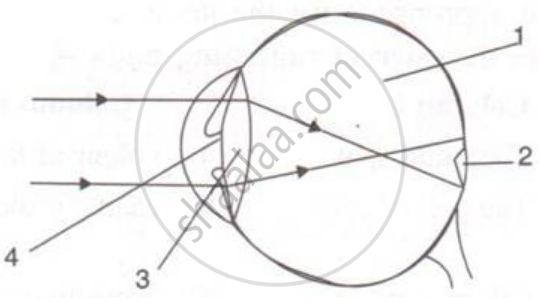
Name the type of lens used to correct this eye defect.
Name an old age eye defect. Why is it caused?
Name the following:
The defect of the human eye caused due to the uneven surface of the cornea.
Complete the following sentence with appropriate word :
An inability to focus on nearby objects due to loss of elasticity of the lens with age is called Iris.
The diagram given below represents the cross-section of the human eye:

(i) Name the parts labeled 1—12.
(ii) What is the function of the part marked ‘10’?
(iii) What would happen if part ‘5’ is damaged or cut?
Which of the following statement is correct?
State reasons for Myopia. With the help of ray diagrams, show the:
- image formation by a myopic eye, and
- correction of myopia using an appropriate lens.
Match the following:
| Column - I | Column - II |
| 1. Retina | a. Path way of light |
| 2. Pupil | b. Far point comes closer |
| 3. Ciliary muscles | c. near point moves away |
| 4. Myopia | d. Screen of the eye |
| 5. Hypermetropia | e. Power of accommodation |
