Advertisements
Advertisements
Question
Have a look at the posture of this girl who is reading a book and answer the questions which follow:
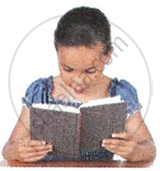 |
- Name the problem she is facing.
- What are the two conditions shown in sections A and B of the eye as applicable to her.
- What kind of reading glasses does she need?
 |
 |
| A | B |
Advertisements
Solution
- Myopia
- Section A depicts hyperopia, which occurs when the picture forms behind the retina. Section Bis depicts myopia, a condition where the picture forms before the retina.
- She requires reading glasses with a concave lens.
APPEARS IN
RELATED QUESTIONS
What is the far point of a person suffering from myopia (or short-sightedness)?
Your friend can read a book perfectly well but cannot read the writing on blackboard unless she sits on the front row in class.
What type of lenses-converging or diverging-would an optician prescribe for her?
Explain with the help of labelled ray diagram, the defect of vision called myopia and how it is corrected by a lens.
A person cannot see the distant objects clearly (though he can see the nearby objects clearly). He is suffering from the defect of vision called:
(a) cataract
(b) hypermetropia
(c) myopia
(d) presbyopia
Though a woman can see the distant object clearly, she cannot see the nearby objects clearly. She is suffering from the defect of vision called:
(a) long-sight
(b) short-sight
(c) hind-sight
(d) mid-sight
What is Hypermetropia (far sightedness)?
List two causes of presbyopia. Draw labelled diagram of a lens used for the correction of this defect of vision.
Write whether the following is true or false:
A convex lens is used for correcting myopia.
Give Reason:
When you enter into a dark room from bright because of sunlight, you can not see things for a few seconds.
Complete the following table by observing the given figures:
| Figure → |  |
 |
| Points ↓ | ||
| (a) Name of the defect | ______ | ______ |
| (b) Position of the image | ______ | ______ |
| (c) Lens used to correct the defect | ______ | ______ |
