Advertisements
Advertisements
Question
The figure given below shows the principal parts of a human ear. Study the diagram and answer the following questions.
 |
- Label the parts 1 to 8.
- State the role of parts 6, 7 and 8.
- Why is it harmful to use a sharp object to remove ear wax? Mention the number and name of the part involved.
Advertisements
Solution
-
- Pinna
- Ear drum
- Ear canal
- Hammer
- Semi-circular canal
- Cochlea
- Vestibular portion of auditory nerve.
- Eustachian Tube
- Part 6 (Cochlea): It contains sensory cells for hearing.
Part 7 (Auditory Nerve): It transmits the impulse of hearing to the brain.
Part 8 (Eustachian Tube): It equalises air pressure on both sides of the tympanum. - Sharp objects may damage the (part 3) ear drum and cause deafness. Deafness can result from eardrum or tympanic ruptures.
APPEARS IN
RELATED QUESTIONS
Draw labelled diagrams of the following: Ear
Differentiate between the Rods and Cones of Retina (Type of pigment)
The ear ossicle which is attached to the tympanum.
The three parts of human ear contributing in hearing are-
With reference to the human ear, answer the question that follow:
Give the technical term for the structure found in the inner ear.
There are three small bones in the muddle ear – anvil, hammer and stirrup :
(a) Which of these bones is in touch with ear-drum ?
(b) Which of these bones is in touch with oval window ?
Mention, if the following statement is True or False
The part of ear associated with balance is the cochlea.
Vibrating particles travel all the way from the vibrating objects to the ear.
With reference to human ear answer the question that follow:
Name the part of the ear associated with the amplification of vibrations.
Given below is the diagram of a part of the human ear. Study the same and answer the questions that follow:
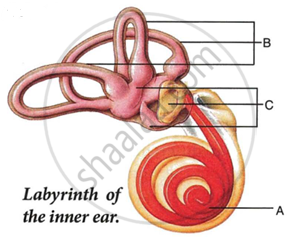 |
- Give the collective biological term for Malleus, locus and Stapes.
- Name the parts labelled A, B and C in the diagram.
- State the functions of the parts labelled 'A' and 'B'.
- Name the audio receptor region present in the part labelled 'A'.
