Advertisements
Advertisements
Question
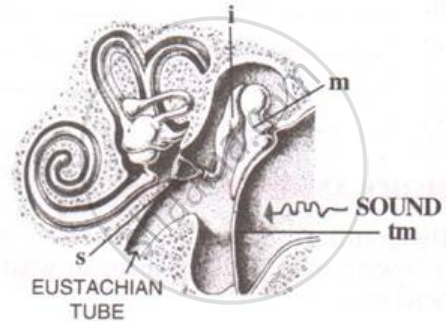
Given below is the diagram of the human ear. Study the diagram and then answer the questions that follow:

(i) What role does the eardrum play in hearing?
(ii) What common term is given to the parts labeled A, B, and E?
(iii) Would there be any difference if these three parts mentioned in (ii) above were replaced by one by one? Why?
(iv) Give the biological term for the parts labeled C and D.
(v) Name the fluid which fills the parts mentioned in (iv) above.
(vi) State the functions of the ear.
Advertisements
Solution
(i) The eardrum is vibrated by sound waves and passes them to the internal ear.
(ii) Ear ossicles.
(iii) One big ossicle would not be able to produce effective amplification because it would require a greater force of vibration that supplied by the eardrum normally. Moreover, three smaller ossicles with proper distance between their produce multiple amplification and effective transmission.
(iv) C is semi-circular canals and D is the cochlea.
(v) Endolymph.
(vi) Hearing and balancing of the body.
RELATED QUESTIONS
Explain how the human ear works.
Time taken by an object to complete one oscillation is called ___________.
The unit of frequency is ______.
State the exact location of the Ciliary body
the biological/technical terms for a thin membrane covering the entire front part of the eye.
Give technical terms for The nerve which transmits impulses from the ear to the brain
Perilymph or endolymph (Which one surrounds the organ of Corti?)
Differentiate between members of the following pair with reference to what is asked in bracket.
Dynamic balance and static balance (Definition)
Name the part of the ear associated with hearing.
The figure below is the sectional view of a part of the skull showing s sense organ:
Name the sense organ.
