Advertisements
Advertisements
Question
With respect to human eye explain:
(i) How is the image formed on the retina?
(ii) How is the amount of light entering the eye-controlled?
(iii) What type of lens is used for the correction of ‘Long sight’ defect?
(iv) With the help of a ray, diagram show the defect of the eye and then its correction after the use of a lens.
Advertisements
Solution
(i) Light from the source when reaching the eye, it gets converted by the lens and an inverted image is formed on the retina.
(ii) The amount of light entering the eye can be controlled by dilating or constricting the pupil.
(iii) A biconcave lens is used to correct long-sightedness.
(iv)

RELATED QUESTIONS
the biological/technical terms for the lens of eye losing flexibility resulting in a kind of long-sightedness in middle aged people.
Name the defect of vision in a person:
whose near point is more than 25 on away.
Name the defect of vision in a person:
whose far point is less than infinity
Name the following:
The eye defect caused due to shortening of the eye ball from front to back.
Choose the odd one out from the following terms and name the category to which the others belong.
Endolymph, Tympanic membrane, Semi-circular canal, Blind spot
Given alongside is a diagram depicting a defect of the human eye. Study the same and then answer the questions that follow:
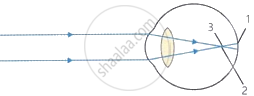
- Identify the defect.
- Name the parts labelled 1, 2 and 3.
- Give two possible reasons for this eye defect.
- Draw a labelled diagram to show how the above mentioned defect is rectified.
Have a look at the posture of this woman who is reading a book and answer the questions which follow:

What kind of looking glasses she needs?
Name the common defects of the eye.
Choose the Odd One Out:
Myopia may arise due to ____________.
