Advertisements
Advertisements
Question
Name the defect of vision in a person:
whose near point is more than 25 on away.
Advertisements
Solution
Hypermetropia is the defect of vision in a person whose near point is more than 25 cm away.
APPEARS IN
RELATED QUESTIONS
A student is unable to see clearly the words written on the blackboard placed at a distance of approximately 4 m from him. Name the defect of vision the boy is suffering from. Explain the method of correcting this defect.
Draw ray diagram for the:-
(i) defect of vision and also
(ii) for its correction.
A student is unable to see clearly the words written on the black board placed at a distance of approximately 3 m from him. Name the defect of vision the boy is suffering from. State the possible causes of this defect and explain the method of correcting it.
A man can read the number of a distant bus clearly but he finds difficulty in reading a book.
- From which defect of the eye is he suffering?
- What type of spectacle lens should he use to correct the defect?
Name the defect of vision which can be corrected by a diverging lens. Show clearly by a ray diagram how the lens corrects the defect.
A person suffering from the eye-defect myopia (short-sightedness) can see clearly only up to a distance of 2 metres. What is the nature and power of lens required to rectify this defect?
A person having short-sight cannot see objects clearly beyond a distance of 1.5 m. What would be the nature and power of the corrective lens to restore proper vision?
What is long-sightedness? State the two causes of long-sightedness (or hypermetropia). With the help of ray diagrams, show:
(i) the eye-defect long-sightedness.
(ii) correction of long-sightedness by using a lens.
The defect of vision which cannot be corrected by using spectacles is:
(a) myopia
(b) presbyopia
(c) cataract
(d) hypermetropia
A young man has to hold a book at arm's length to be able to read it clearly. The defect of vision is:
(a) astigmatism
(b) myopia
(c) presbyopia
(d) hypermetropia
The near point of a long-sighted person is 50 cm from the eye.
- Can she see clearly an object at:
- a distance of 20 cm?
- at infinity?
- To read a book held at a distance of 25 cm, will she need converging or diverging spectacle lenses?
A person can read a book clearly only if he holds it at an arm's length from him. Name the defect of vision:
if the person is a young man
Which part of the eye is grafted in a needy patient from a donated eye?
What is Hypermetropia (far sightedness)?
Given alongside is a diagram depicting a defect of the human eye. Study the same and then answer the questions that follow:
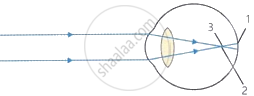
- Identify the defect.
- Name the parts labelled 1, 2 and 3.
- Give two possible reasons for this eye defect.
- Draw a labelled diagram to show how the above mentioned defect is rectified.
Explain the Term: Presbyopia
What type of lens is used to correct Astigmatism?
With respect to human eye explain:
(i) How is the image formed on the retina?
(ii) How is the amount of light entering the eye-controlled?
(iii) What type of lens is used for the correction of ‘Long sight’ defect?
(iv) With the help of a ray, diagram show the defect of the eye and then its correction after the use of a lens.
A person needs a lens of power –4.5 D for correction of her vision.
- What kind of defect in vision is she suffering from?
- What is the focal length of the corrective lens?
- What is the nature of the corrective lens?
