Advertisements
Advertisements
Question
Given alongside is a diagram depicting a defect of the human eye. Study the same and then answer the questions that follow:
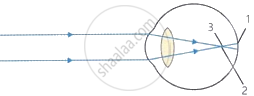
- Identify the defect.
- Name the parts labelled 1, 2 and 3.
- Give two possible reasons for this eye defect.
- Draw a labelled diagram to show how the above mentioned defect is rectified.
Advertisements
Solution
- Myopia
- 1: Vitreous humour
2: Fovea
3: Optic nerve - Lengthening of the eyeball from front to back.
Lens is too curved. 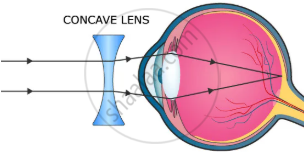
APPEARS IN
RELATED QUESTIONS
Do you know that the corneal-impairment can be cured by replacing the defective cornea with the cornea of the donated eye? How and why should we organise groups to motivate the community members to donate their eyes after death?
Name the defect of vision in a person:
whose near point is more than 25 on away.
Your friend can read a book perfectly well but cannot read the writing on blackboard unless she sits on the front row in class.
What type of lenses-converging or diverging-would an optician prescribe for her?
A student sitting in the last row of the class-room is not able to read clearly the writing on the blackboard.
How can this defect by corrected?
A person suffering from the eye-defect myopia (short-sightedness) can see clearly only up to a distance of 2 metres. What is the nature and power of lens required to rectify this defect?
List two causes of presbyopia. Draw labelled diagram of a lens used for the correction of this defect of vision.
Nearsightedness : concave lens : : farsightedness : _______
Observe the figure and answer the following questions:

- Name the defect of vision represented in the above figure.
- State the reasons for this defect.
- How is it corrected?
- Draw the diagram to show the correction of this defect.
Name the following:
Two kinds of accomodations.
Have a look at the posture of this girl who is reading a book and answer the questions which follow:
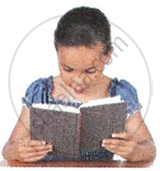 |
- Name the problem she is facing.
- What are the two conditions shown in sections A and B of the eye as applicable to her.
- What kind of reading glasses does she need?
 |
 |
| A | B |
