Advertisements
Advertisements
प्रश्न
Given alongside is a diagram depicting a defect of the human eye. Study the same and then answer the questions that follow:
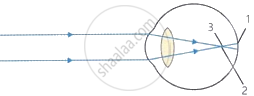
- Identify the defect.
- Name the parts labelled 1, 2 and 3.
- Give two possible reasons for this eye defect.
- Draw a labelled diagram to show how the above mentioned defect is rectified.
Advertisements
उत्तर
- Myopia
- 1: Vitreous humour
2: Fovea
3: Optic nerve - Lengthening of the eyeball from front to back.
Lens is too curved. 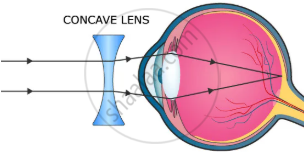
APPEARS IN
संबंधित प्रश्न
About 45 lac people in the developing countries are suffering from corneal blindness. About 30 lac children below the age of 12 years suffering from this defect can be cured by replacing the defective cornea with the cornea of a donated eye. How and why can students of your age involve themselves to create awareness about this fact among people?
What is the other name of old age hypermetropia?
What is long-sightedness? State the two causes of long-sightedness (or hypermetropia). With the help of ray diagrams, show:
(i) the eye-defect long-sightedness.
(ii) correction of long-sightedness by using a lens.
Though a woman can see the distant object clearly, she cannot see the nearby objects clearly. She is suffering from the defect of vision called:
(a) long-sight
(b) short-sight
(c) hind-sight
(d) mid-sight
A student cannot see a chart hanging on a wall placed at a distance of 3 m from him. Name the defect of vision he is suffering from. How can it be corrected? Draw ray diagrams for the (i) defect of vision and also (ii) for its correction.
What is Hypermetropia (far sightedness)?
When do we consider a student sitting in the class to be myopic? List two causes of this defect. Explain using a ray diagram how this defect of eye can be corrected.
Draw a neat labeled diagram to show how hypermetropia can be rectified.
Explain the Term: Hypermetropia
Correlate the given sequence:
Hypermetropia : Convex lens : ______ : Concave lens
