Advertisements
Advertisements
प्रश्न
What is long-sightedness? State the two causes of long-sightedness (or hypermetropia). With the help of ray diagrams, show:
(i) the eye-defect long-sightedness.
(ii) correction of long-sightedness by using a lens.
Advertisements
उत्तर
Long-sightedness, or hypermetropia, is a defect of vision because of which a person cannot see nearby objects clearly but has normal distant vision. Hypermetropia occurs because
1. the eye lens has low converging power, which causes the formation of the images of objects behind the retina, or
2. the eye ball is too short, which causes the formation of the images of objects behind the retina
The ray diagram shows the hypermetropic eye and how the defect is corrected by using a convex lens, which converges the light rays from objects and forms clear images on the retina.

APPEARS IN
संबंधित प्रश्न
Do you know that the corneal-impairment can be cured by replacing the defective cornea with the cornea of the donated eye? How and why should we organise groups to motivate the community members to donate their eyes after death?
A person with a myopic eye cannot see objects beyond 1.2 m distinctly. What should be the type of the corrective lens used to restore proper vision?
Name any two defects of vision which can be corrected by using spectacles.
A student sitting in the last row of the class-room is not able to read clearly the writing on the blackboard.
- Name the type of defect he is suffering from.
- How can this defect by corrected?
The near-point of a person suffering from hypermetropia is at 50 cm from his eye. What is the nature and power of the lens needed to correct this defect? (Assume that the near-point of the normal eye is 25 cm).
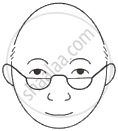
The picture given here shows a person wearing ‘half-moon’ spectacles. What sort of eye-defect do you think he has? Why are these particular spectacles useful to him?
Which part of the eye is grafted in a needy patient from a donated eye?
An old man cannot see objects closer than 1 m from the eye clearly. Name the defect of vision he is suffering from. How can it be corrected? Draw ray diagram for the (i) defect of vision and also (ii) for its correction.
List two causes of presbyopia. Draw labelled diagram of a lens used for the correction of this defect of vision.
Choose the odd one out from the following terms and name the category to which the others belong.
Endolymph, Tympanic membrane, Semi-circular canal, Blind spot
The near point of the eye of a person is 50 cm. Find the nature and power of the corrective lens required by the person to enable him to see clearly the objects placed at 25 cm from the eye?
Give Reason:
Deficiency of vitamin A causes night blindness.
Explain the Term: Astigmatism
With respect to human eye explain:
(i) How is the image formed on the retina?
(ii) How is the amount of light entering the eye-controlled?
(iii) What type of lens is used for the correction of ‘Long sight’ defect?
(iv) With the help of a ray, diagram show the defect of the eye and then its correction after the use of a lens.
In Myopia the human eye _______.
Given below is a diagram showing a defect of vision. Name the defect of vision and draw an accurately labelled diagram to correct this defect.
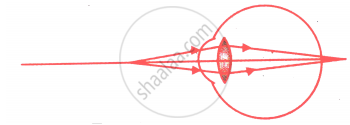
Draw ray diagram showing myopic eye.
A teacher drew the diagram of the heart on the blackboard and told the students to copy it in their notebooks. Mahesh couldn't see the diagram clearly as it appeared blurred to him.
- Name the defect of the eye Mahesh is suffering from.
- Where is the image formed in this defect?
- Mahesh consults an eye doctor and is prescribed suitable lenses to correct the defect. Which type of lens do his spectacles have?
Name the following:
Two kinds of accomodations.
