Advertisements
Advertisements
प्रश्न
The near-point of a person suffering from hypermetropia is at 50 cm from his eye. What is the nature and power of the lens needed to correct this defect? (Assume that the near-point of the normal eye is 25 cm).
Advertisements
उत्तर
A person suffering from hypermetropia can correct the defect by wearing spectacles with convex lenses. In order to find the power of the convex lens required, we have to first calculate its focal length.
Given that the near point of the hypermetropic eye is 50 cm in front of the eye (the person can see an object kept at the normal near point of 25 cm from the eye if the image of the object is formed at the person's own near point of 50 cm from the eye).
u = -25 cm (the distance of the object at the normal near point)
v = -50 cm (the location of the near point of the defective eye)
f = ? (focal length)
The focal length can be calculated using the lens formula `1/v-1/u=1/f`
Substituting the values in the formula, we get `1/50-1/-25=1/f`
`1/-50+1/25=1/f`
`((-1+2))/50=1/50=1/f`
∴f=50cm=0.5cm
Now that we know the focal length of the convex lens, the power can be calculated.
Power P=`1/f(termertrs)`
∴` P=1/0.5=+diopters`
Hence, the power of the convex lens required to rectify this defect is +2 dioptres.
APPEARS IN
संबंधित प्रश्न
In a Std. X class out of 40 students 10 students use spectacles, 2 students have positive power and 8 students have negative power of lenses in their spectacles.
Answer the following questions:
(1) What does the negative power indicate?
(2) What does the positive power indicate?
(3) Generally which type of spectacles do most of the students use?
(4) What defect of eyesight do most of the students suffer from?
(5) Give two possible reasons for the above defect.
Explain two possible reasons of myopia. How can it be corrected? Explain with a suitable diagram.
Name the defect of vision in a person:
whose far point is less than infinity
Name the defect of vision which makes the eye-lens cloudy resulting in blurred vision.
Name the body part with which the terms myopia and hypermetropia are connected.
A person cannot see the distant objects clearly (though he can see the nearby objects clearly). He is suffering from the defect of vision called:
(a) cataract
(b) hypermetropia
(c) myopia
(d) presbyopia
A person can read a book clearly only if he holds it at an arm's length from him. Name the defect of vision:
if the person is a young man
By closing the eyes and gently pressing them by your palms, you may see some specks of brilliant light. How do you get this sensation while there is no light entering your eyes?
Explain the terms ‘adaptation’ and ‘accommodation’ with reference to the eye.
Draw a ray diagram to show how Hypermetropia is defect can be corrected using a lens.
State the main functions of the following:
Tears
A person is unable to see objects distinctly placed within 50 cm from his eyes.
(a) Name the defect of vision the person is suffering from and list its two possible causes.
(b) Draw a ray diagram to show the defect in the above case.
(c) Mention the type of lens used by him for the correction of the defect and calculate its power. Assume that the near point for the normal eye is 25 cm.
(d) Draw a labeled diagram for the correction of the defect in the above case.
Differentiate between:
Short-sightedness and Long-sightedness.
With respect to human eye explain:
(i) How is the image formed on the retina?
(ii) How is the amount of light entering the eye-controlled?
(iii) What type of lens is used for the correction of ‘Long sight’ defect?
(iv) With the help of a ray, diagram show the defect of the eye and then its correction after the use of a lens.
Nearsightedness: elongated eyeball : : farsightedness: _______
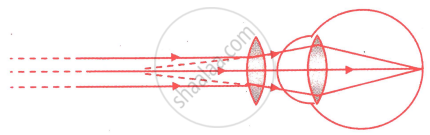
Observe the given below the figure, correct it and explain and write about the concept depicted in this figure.
A person needs a lens of power –4.5 D for correction of her vision.
- What kind of defect in vision is she suffering from?
- What is the focal length of the corrective lens?
- What is the nature of the corrective lens?
A person is unable to see clearly a poster fixed on a distant wall. He however sees it clearly when standing at a distance of about 2 m from the wall.
- Draw ray diagram to show the formation of image by his eye lens when he is far away from the wall.
- List two possible reasons of this defect of vision.
- Draw ray diagram to show the correction of this defect using appropriate lens.
Given alongside is a diagram depicting a defect of the human eye. Study the same and answer the questions that follow:
 |
- Name the defect shown in the diagram.
- Give two possible reasons for this defect.
- Name the parts labelled 1 to 4.
- Name the type of lens used to correct this eye defect.
- Draw a labelled diagram to show how the above mentioned defect is rectified using the lens named above.
