Advertisements
Advertisements
प्रश्न
The near-point of a person suffering from hypermetropia is at 50 cm from his eye. What is the nature and power of the lens needed to correct this defect? (Assume that the near-point of the normal eye is 25 cm).
Advertisements
उत्तर
A person suffering from hypermetropia can correct the defect by wearing spectacles with convex lenses. In order to find the power of the convex lens required, we have to first calculate its focal length.
Given that the near point of the hypermetropic eye is 50 cm in front of the eye (the person can see an object kept at the normal near point of 25 cm from the eye if the image of the object is formed at the person's own near point of 50 cm from the eye).
u = -25 cm (the distance of the object at the normal near point)
v = -50 cm (the location of the near point of the defective eye)
f = ? (focal length)
The focal length can be calculated using the lens formula `1/v-1/u=1/f`
Substituting the values in the formula, we get `1/50-1/-25=1/f`
`1/-50+1/25=1/f`
`((-1+2))/50=1/50=1/f`
∴f=50cm=0.5cm
Now that we know the focal length of the convex lens, the power can be calculated.
Power P=`1/f(termertrs)`
∴` P=1/0.5=+diopters`
Hence, the power of the convex lens required to rectify this defect is +2 dioptres.
APPEARS IN
संबंधित प्रश्न
List three common refractive defects of vision. Suggest the way of correcting these defects.
Name the defect of vision in a person:
whose far point is less than infinity
Your friend can read a book perfectly well but cannot read the writing on blackboard unless she sits on the front row in class.
- Is she short-sighted or long-sighted?
- What type of lenses-converging or diverging-would an optician prescribe for her?
What is long-sightedness? State the two causes of long-sightedness (or hypermetropia). With the help of ray diagrams, show:
(i) the eye-defect long-sightedness.
(ii) correction of long-sightedness by using a lens.
To read a book held at a distance of 25 cm, will she need converging or diverging spectacle lenses?
A person can read a book clearly only if he holds it at an arm's length from him. Name the defect of vision:
if the person is a young man
Name the following:
The photosensitive pigment present in the rods of the retina.
By closing the eyes and gently pressing them by your palms, you may see some specks of brilliant light. How do you get this sensation while there is no light entering your eyes?
Observer the following diagram and answer the questions.
a) Which eye defect is shown in this diagram?
b) What are the possible reasons for this eye defect?
c) How this defect is corrected, write it in brief?

Distinguish between the following pair of words:
Myopia and hypermetropia
Given alongside is a diagram depicting a defect of the human eye. Study the same and then answer the questions that follow:
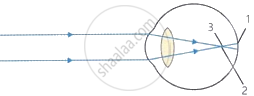
- Identify the defect.
- Name the parts labelled 1, 2 and 3.
- Give two possible reasons for this eye defect.
- Draw a labelled diagram to show how the above mentioned defect is rectified.
Give Reason:
When you enter into a dark room from bright because of sunlight, you can not see things for a few seconds.
Explain the Term: Hypermetropia
Mention, if the following statement is True or False
Hypermetropia is a defect of the eye caused due to the eyeball elongation
In Myopia the human eye _______.
Differentiate the eye defects: Myopia and Hypermetropia
Myopia and hypermetropia can be corrected by:
State reasons for Myopia. With the help of ray diagrams, show the:
- image formation by a myopic eye, and
- correction of myopia using an appropriate lens.
Match the following:
| Column - I | Column - II |
| 1. Retina | a. Path way of light |
| 2. Pupil | b. Far point comes closer |
| 3. Ciliary muscles | c. near point moves away |
| 4. Myopia | d. Screen of the eye |
| 5. Hypermetropia | e. Power of accommodation |
Have a look at the posture of this girl who is reading a book and answer the questions which follow:
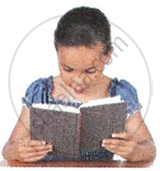 |
- Name the problem she is facing.
- What are the two conditions shown in sections A and B of the eye as applicable to her.
- What kind of reading glasses does she need?
 |
 |
| A | B |
