Advertisements
Advertisements
Question
Choose the Odd One Out:
Options
Myopia
Hypermetropia
Xerophthalmia
Astigmatism
Advertisements
Solution
Xerophthalmia
RELATED QUESTIONS
Where is the near point of a person suffering from hypermetropia (or long-sightedness)?
Explain with the help of labelled ray-diagram, the defect of vision called hypermetropia, and hot it is corrected by a lens.
A person suffering from the eye-defect myopia (short-sightedness) can see clearly only up to a distance of 2 metres. What is the nature and power of lens required to rectify this defect?
The defect of vision in which the eye-lens of a person gets progressively cloudy resulting in blurred vision is called:
(a) myopia
(b) presbyopia
(c) colourblindness
(d) cataract
Differentiate between members of the following pair with reference to what is asked in the bracket.
Rods and cones (sensitivity).
A person cannot read newspaper placed nearer than 50 cm from his eyes. Name the defect of vision he is suffering from. Draw a ray diagram to illustrate this defect. List its two possible causes. Draw a ray diagram to show how this defect may be corrected using a lens of appropriate focal length.
Observer the following diagram and answer the questions.
a) Which eye defect is shown in this diagram?
b) What are the possible reasons for this eye defect?
c) How this defect is corrected, write it in brief?

Given below is a diagram depicting a defect of the human eye? Study the same and answer the question that follow :
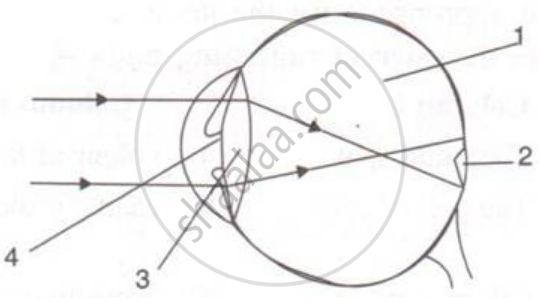
Name the type of lens used to correct this eye defect.
Explain the Term: Astigmatism
Mention, if the following statement is True or False
Hypermetropia is a defect of the eye caused due to the eyeball elongation
