Advertisements
Advertisements
Question
Where is the near point of a person suffering from hypermetropia (or long-sightedness)?
Advertisements
Solution
The near point of a person suffering from hypermetropia is more than 25 centimetres away.
APPEARS IN
RELATED QUESTIONS
About 45 lac people in the developing countries are suffering from corneal blindness. About 30 lac children below the age of 12 years suffering from this defect can be cured by replacing the defective cornea with the cornea of a donated eye. How and why can students of your age involve themselves to create awareness about this fact among people?
A person with a myopic eye cannot see objects beyond 1.2 m distinctly. What should be the type of the corrective lens used to restore proper vision?
Explain two possible reasons of myopia. How can it be corrected? Explain with a suitable diagram.
What are the two most common defects of vision (or defects of eye)? How are they corrected?
What is short-sightedness? State the two causes of short-sightedness (or myopia). With the help of ray diagrams, show:
(i) the eye-defect short-sightedness.
(ii) correction of short-sightedness by using a lens.
An eye has a far point of 2 m. What type of lens in spectacles would be needed to increase the far point to infinity? Also calculate the power of lens required. Is this eye long-sighted or short-sighted?
The defect of vision which cannot be corrected by using spectacles is:
(a) myopia
(b) presbyopia
(c) cataract
(d) hypermetropia
Though a woman can see the distant object clearly, she cannot see the nearby objects clearly. She is suffering from the defect of vision called:
(a) long-sight
(b) short-sight
(c) hind-sight
(d) mid-sight
Which part of the eye is grafted in a needy patient from a donated eye?
Describe the mechanism of focusing the image of a distant object in your eye when you raise your head after reading a book.
An old man cannot see objects closer than 1 m from the eye clearly. Name the defect of vision he is suffering from. How can it be corrected? Draw ray diagram for the (i) defect of vision and also (ii) for its correction.
Give Reason:
Older people require glasses to read and write.
Differentiate between:
Short-sightedness and Long-sightedness.
Draw a neat labeled diagram to show how hypermetropia can be rectified.
Explain the Term: Cataract
Complete the following sentence with appropriate word :
An inability to focus on nearby objects due to loss of elasticity of the lens with age is called Iris.
Choose the Odd One Out:
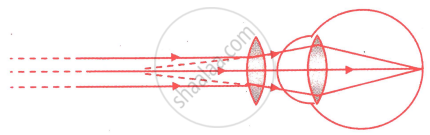
Observe the given below the figure, correct it and explain and write about the concept depicted in this figure.
A person cannot see distinctly objects kept beyond 2 m. This defect can be corrected by using a lens of power:
When do we consider a person to be myopic or hypermetropic? Explain using diagrams how the defects associated with myopic and hypermetropic eye can be corrected?
