Advertisements
Advertisements
प्रश्न
Where is the near point of a person suffering from hypermetropia (or long-sightedness)?
Advertisements
उत्तर
The near point of a person suffering from hypermetropia is more than 25 centimetres away.
APPEARS IN
संबंधित प्रश्न
The kind of lens required to correct Myopia
the biological/technical terms for the lens of eye losing flexibility resulting in a kind of long-sightedness in middle aged people.
Your friend can read a book perfectly well but cannot read the writing on blackboard unless she sits on the front row in class.
What type of lenses-converging or diverging-would an optician prescribe for her?
A man can read the number of a distant but clearly but he finds difficulty in reading a book.
What type of spectacle lens should he use to correct the defect?
Though a woman can see the distant object clearly, she cannot see the nearby objects clearly. She is suffering from the defect of vision called:
(a) long-sight
(b) short-sight
(c) hind-sight
(d) mid-sight
A person can read a book clearly only if he holds it at an arm's length from him. Name the defect of vision:
if the person is a young man
Name the following:
The eye defect caused due to shortening of the eye ball from front to back.
You do not enjoy watching a movie from a very short distance from the screen in a cinema hall. Why?
Given below is a diagram depicting a defect of the human eye. Study the same and answer the question that follow:

Name the defect shown in the diagram.
What is Hypermetropia (far sightedness)?
Given alongside is a diagram depicting a defect of the human eye. Study the same and then answer the questions that follow:
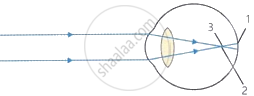
- Identify the defect.
- Name the parts labelled 1, 2 and 3.
- Give two possible reasons for this eye defect.
- Draw a labelled diagram to show how the above mentioned defect is rectified.
Anuja cannot see the blackboard writing but she can see nearby things.
(a) What is the eye defect she is suffering from?
(b) State the possible reason for her defect.
(c) How is it corrected
In what two whys is a yellow spot different from the blind spot?
Explain the Term: Presbyopia
Explain the Term: Astigmatism
What are the causes of ‘Myopia’?
A person cannot see distinctly objects kept beyond 2 m. This defect can be corrected by using a lens of power:
Myopia may arise due to ____________.
State reasons for Myopia. With the help of ray diagrams, show the:
- image formation by a myopic eye, and
- correction of myopia using an appropriate lens.
Match the following:
| Column - I | Column - II |
| 1. Retina | a. Path way of light |
| 2. Pupil | b. Far point comes closer |
| 3. Ciliary muscles | c. near point moves away |
| 4. Myopia | d. Screen of the eye |
| 5. Hypermetropia | e. Power of accommodation |
