English

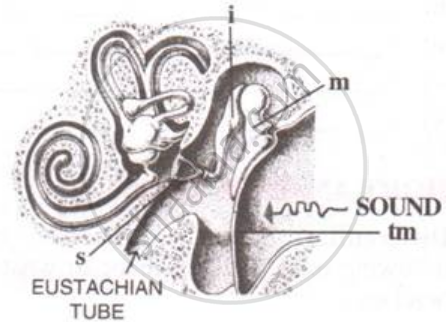
Name the following: The ear ossicle attached to the tympanum.

Advertisements
Advertisements

Question

Name the following:

The ear ossicle attached to the tympanum.

One Word/Term Answer
Advertisements

Solution

Malleus (hammer)

shaalaa.com
  Is there an error in this question or solution?
Chapter 11: Sense Organs - Review Questions [Page 153]

APPEARS IN

Selina Concise Biology [English] Class 10 ICSE
Chapter 11 Sense Organs
Review Questions | Q B. (c) | Page 153

RELATED QUESTIONS

State the main function of the Eustachian tube


(i) Draw a well labelled diagram of the membranous labyrinth found in the inner ear.
(ii) Based on the diagram drawn above in (i) give a suitable term for each of the following descriptions :
1. The sensory cells that helps in hearing.
2. The part that is responsible for static balance of the body.
3. The membrane covered opening that connects the middle ear to the inner ear.
4. The fluid present in the middle chamber of cochlea.
5. The structure that maintains dynamic equilibrium of the body.


A fluid that occupies the larger cavity of the eye ball behind the lens is
___________.


There are three small bones in the muddle ear – anvil, hammer and stirrup :
(a) Which of these bones is in touch with ear-drum ?
(b) Which of these bones is in touch with oval window ?


Choose the correct answer.
Canal joining middle ear to pharynx ___________


Choose the correct answer : 
Organ of corti is found in ___________


Long answer question

Draw the neat labelled diagram of the human ear.


The part of the ear that turns pressure variations into electrical signals is ______.


Note the relationship between the first two words and suggest the suitable word/words for the fourth place.

Ear pinna : Auricle :: Inner ear : ______.


Given below is the diagram of a part of the human ear. Study the same and answer the questions that follow:

  1. Give the collective biological term for Malleus, locus and Stapes.
  2. Name the parts labelled A, B and C in the diagram.
  3. State the functions of the parts labelled 'A' and 'B'.
  4. Name the audio receptor region present in the part labelled 'A'.

Share
Notifications

Englishहिंदीमराठी


      Forgot password?
Use app×