Advertisements
Advertisements
प्रश्न
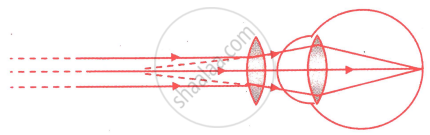
Given below is a diagram showing a defect of human eye. Study it and answer the following questions.

(i) Name the defect shown in the figure.
(ii) Give reason for this defect of eye in human being.
(iii) Name the type of lens used to correct the eye defect.
Advertisements
उत्तर
(i) The defect shown in the figure is hypermetropia or long-sightedness.
(ii) Two possible reasons are
a) Ciliary muscles have become weak, so the converging power of the eye lens decreases.
b) Because of shortening of the eye ball or flattening of the eye lens.
(iii) To correct the eye defect, a suitable convex lens is used.
APPEARS IN
संबंधित प्रश्न
The far point of a myopic person is 80 cm in front of the eye. What is the nature and power of the lens required to correct the problem?
Explain two possible reasons of myopia. How can it be corrected? Explain with a suitable diagram.
Name the defect of vision in which the eye-lens loses its power of accommodation due to old age.
Name the defect of vision which makes the eye-lens cloudy resulting in blurred vision.
What is the other name of old age hypermetropia?
What are the two most common defects of vision (or defects of eye)? How are they corrected?
Name the defect of vision which can be corrected by a converging lens. Show clearly by a ray diagram how the lens corrects the defect.
Name the defect of vision which can be corrected by a diverging lens. Show clearly by a ray diagram how the lens corrects the defect.
A person suffering from the eye-defect myopia (short-sightedness) can see clearly only up to a distance of 2 metres. What is the nature and power of lens required to rectify this defect?
An eye has a near point distance of 0.75 m. What sort of lens in spectacles would be needed to reduce the near point distance to 0.25 m? Also calculate the power of lens required. Is this eye long-sighted or short-sighted?
An eye has a far point of 2 m. What type of lens in spectacles would be needed to increase the far point to infinity? Also calculate the power of lens required. Is this eye long-sighted or short-sighted?
A young man has to hold a book at arm's length to be able to read it clearly. The defect of vision is:
(a) astigmatism
(b) myopia
(c) presbyopia
(d) hypermetropia
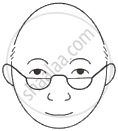
The picture given here shows a person wearing ‘half-moon’ spectacles. What sort of eye-defect do you think he has? Why are these particular spectacles useful to him?
Which part of the eye is grafted in a needy patient from a donated eye?
Differentiate between members of the following pair with reference to what is asked in the bracket.
Rods and cones (sensitivity).
By closing the eyes and gently pressing them by your palms, you may see some specks of brilliant light. How do you get this sensation while there is no light entering your eyes?
Draw a ray diagram to show how Hypermetropia is defect can be corrected using a lens.
Choose the odd one out from the following terms and name the category to which the others belong.
Endolymph, Tympanic membrane, Semi-circular canal, Blind spot
Choose the correct answer :
Presbyopia is a disease of _____________
Given below is a diagram depicting a defect of the human eye? Study the same and answer the question that follow:

Name the parts labeled 1 to 4.
Have a look at the posture of this woman who is reading a book and answer the questions which follow:

What are the two conditions shown in sections A and B of the eye as applicable to her?
The near point of the eye of a person is 50 cm. Find the nature and power of the corrective lens required by the person to enable him to see clearly the objects placed at 25 cm from the eye?
Give Reason:
Older people require glasses to read and write.
Differentiate between:
Myopia and Hypermetropia.
Draw a neat labeled diagram to show how hypermetropia can be rectified.
Name the following:
The defect of the human eye caused due to the uneven surface of the cornea.
Complete the following sentence with appropriate word :
An inability to focus on nearby objects due to loss of elasticity of the lens with age is called Iris.
Given below is a diagrammatic representation of a defect of the human eye:

(i) Identify the defect.
(ii) Mention two reasons for the above defect.
(iii) State how the defect can be rectified.
(iv) Name the part of the eye responsible for maintaining the shape of the eyeball.
Choose the Odd One Out:
Observe the given below the figure, correct it and explain and write about the concept depicted in this figure.
What are the causes of ‘Myopia’?
Assertion: Myopia is the defect of vision in which a person cannot see distant objects clearly.
Reason: This due to eye-ball being too short.
Which of the following statement is correct?
A person needs a lens of power –4.5 D for correction of her vision.
- What kind of defect in vision is she suffering from?
- What is the focal length of the corrective lens?
- What is the nature of the corrective lens?
When do we consider a person to be myopic or hypermetropic? Explain using diagrams how the defects associated with myopic and hypermetropic eye can be corrected?
Observe the figure whether it is correct or not and explain the phenomenon.

