Advertisements
Advertisements
प्रश्न
When do we consider a student sitting in the class to be myopic? List two causes of this defect. Explain using a ray diagram how this defect of eye can be corrected.
Advertisements
उत्तर
Myopia means near sightedness, when a student is unable to use clearly far away objects we consider the student to have myopia.
Causes :
Excessive curvature of the eye lens
Alongation of the eyeball
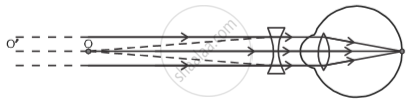
APPEARS IN
संबंधित प्रश्न
Where is the near point of a person suffering from hypermetropia (or long-sightedness)?
The near-point of a person suffering from hypermetropia is at 50 cm from his eye. What is the nature and power of the lens needed to correct this defect? (Assume that the near-point of the normal eye is 25 cm).
An eye has a far point of 2 m. What type of lens in spectacles would be needed to increase the far point to infinity? Also calculate the power of lens required. Is this eye long-sighted or short-sighted?
Name the following:
The photosensitive pigment present in the rods of the retina.
You do not enjoy watching a movie from a very short distance from the screen in a cinema hall. Why?
What eye defect is hypermetropia? Describe with a ray diagram how this defect of vision can be corrected by using an appropriate lens.
A person is unable to see objects distinctly placed within 50 cm from his eyes.
(a) Name the defect of vision the person is suffering from and list its two possible causes.
(b) Draw a ray diagram to show the defect in the above case.
(c) Mention the type of lens used by him for the correction of the defect and calculate its power. Assume that the near point for the normal eye is 25 cm.
(d) Draw a labeled diagram for the correction of the defect in the above case.
Differentiate between:
Short-sightedness and Long-sightedness.
Differentiate between:
Myopia and Hypermetropia.
Explain the Term: Astigmatism
