Advertisements
Advertisements
प्रश्न
The far point of a myopic person is 80 cm in front of the eye. What is the nature and power of the lens required to correct the problem?
Advertisements
उत्तर
The person is suffering from an eye defect called myopia. In this defect, the image is formed in front of the retina. Hence, a concave lens is used to correct this defect of vision.
Object distance, u = infinity = ∞
Image distance, v = – 80 cm
Focal length = f
According to the lens formula,
`1/"v" - 1/"u" = 1/"f"`
`1/(-80) - 1/(-∞) = 1/"f"`
`1/(-80) = 1/"f"`
f = −80 cm = −0.80 m ...(concave lens)
∴ power of modified lens,
P = `1/"f"`
= `1/(-0.80 "m")`
= −1.25 D
A concave lens of power −1.25 D is required by the person to correct his defect.
संबंधित प्रश्न
A student suffering from myopia is not able to see distinctly the objects placed beyond 5 m. List two possible reasons due to which this defect of vision may have arisen. With the help of ray diagrams, explain
(i) why the student is unable to see distinctly the objects placed beyond 5 m from his eyes.
(ii) the type of the corrective lens used to restore proper vision and how this defect is corrected by the use of this lens.
(b) If, in this case, the numerical value of the focal length of the corrective lens is 5 m, find the power of the lens as per the new Cartesian sign convention
What is the other name of old age hypermetropia?
Name any two defects of vision which can be corrected by using spectacles.
A man can read the number of a distant but clearly but he finds difficulty in reading a book.
What type of spectacle lens should he use to correct the defect?
A young man has to hold a book at arm's length to be able to read it clearly. The defect of vision is:
(a) astigmatism
(b) myopia
(c) presbyopia
(d) hypermetropia
A person can read a book clearly only if he holds it at an arm's length from him. Name the defect of vision:
- if the person is an old man
- if the person is a young man
Explain the terms ‘adaptation’ and ‘accommodation’ with reference to the eye.
Given below is a diagram depicting a defect of the human eye. Study the same and answer the question that follow:

Name the defect shown in the diagram.
State one role of ciliary muscles in the human eye.
Observer the following diagram and answer the questions.
a) Which eye defect is shown in this diagram?
b) What are the possible reasons for this eye defect?
c) How this defect is corrected, write it in brief?

Name the following:
The photosensitive pigment present in the rod cells of the retina.
Given below is a diagram depicting a defect of the human eye? Study the same and answer the question that follow :
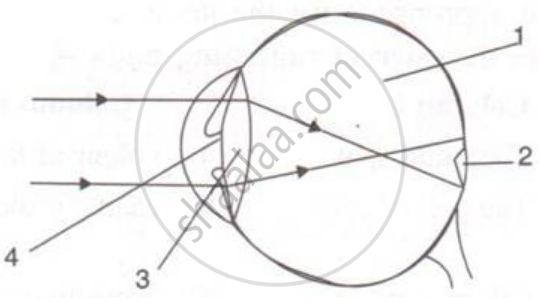
Name the type of lens used to correct this eye defect.
Rewrite the following table so as to match second and third column with first column.
|
Column I
|
Column II
|
Column III
|
|
(i) Myopia
|
Old age problem
|
Bifocal lens
|
|
(ii) Presbyopia
|
Nearsightedness
|
Concave lens.
|
Give Reason:
Older people require glasses to read and write.
What type of lens is used to correct Astigmatism?
With respect to human eye explain:
(i) How is the image formed on the retina?
(ii) How is the amount of light entering the eye-controlled?
(iii) What type of lens is used for the correction of ‘Long sight’ defect?
(iv) With the help of a ray, diagram show the defect of the eye and then its correction after the use of a lens.
Assertion: Concave mirrors are used as reflectors in torches, vehicle head lights and in search lights.
Reason: When an object is placed beyond the center of curvature of a concave mirror, the image formed is real and inverted.
A student sitting at the back of the classroom cannot read clearly the letters written on the blackboard. What advice will a doctor give to her? Draw ray diagram for the correction of this defect.
Observe the figure and answer the following questions:

- Name the defect of vision represented in the above figure.
- State the reasons for this defect.
- How is it corrected?
- Draw the diagram to show the correction of this defect.
Observe the following diagram and answer questions following it:

- Identify the defect of vision shown.
- List its two causes.
- Name the type of lens used for the correction of this defect.
