Advertisements
Advertisements
प्रश्न
A teacher drew the diagram of the heart on the blackboard and told the students to copy it in their notebooks. Mahesh couldn't see the diagram clearly as it appeared blurred to him.
- Name the defect of the eye Mahesh is suffering from.
- Where is the image formed in this defect?
- Mahesh consults an eye doctor and is prescribed suitable lenses to correct the defect. Which type of lens do his spectacles have?
Advertisements
उत्तर
- Myopia or near-sightedness. Individuals suffering from this illness have difficulty seeing distant objects clearly, resulting in fuzzy vision for faraway objects while keeping crisp focus on close ones.
- The image is formed in front of the retina. This issue arises when the eye's power is excessive, which is typically a result of the crystalline lens's shorter focal length.
- A concave lens. A concave lens, which diverges incoming rays and focuses them on the retina, is widely used to rectify this issue.
संबंधित प्रश्न
Name one defect of vision (or eye) which cannot be corrected by any type of spectacle lenses.
What is the far point of a person suffering from myopia (or short-sightedness)?
Differentiate between myopia and hypermetropia.
The defect of vision in which the eye-lens of a person gets progressively cloudy resulting in blurred vision is called:
(a) myopia
(b) presbyopia
(c) colourblindness
(d) cataract
Given alongside is a diagram depicting a defect of the human eye. Study the same and then answer the questions that follow:
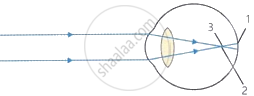
- Identify the defect.
- Name the parts labelled 1, 2 and 3.
- Give two possible reasons for this eye defect.
- Draw a labelled diagram to show how the above mentioned defect is rectified.
Rewrite the following table so as to match second and third column with first column.
|
Column I
|
Column II
|
Column III
|
|
(i) Myopia
|
Old age problem
|
Bifocal lens
|
|
(ii) Presbyopia
|
Nearsightedness
|
Concave lens.
|
Anuja cannot see the blackboard writing but she can see nearby things.
(a) What is the eye defect she is suffering from?
(b) State the possible reason for her defect.
(c) How is it corrected
Give Reason:
Deficiency of vitamin A causes night blindness.
Which of the following statement is correct?
Have a look at the posture of this girl who is reading a book and answer the questions which follow:
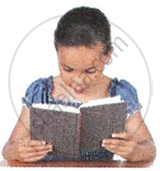 |
- Name the problem she is facing.
- What are the two conditions shown in sections A and B of the eye as applicable to her.
- What kind of reading glasses does she need?
 |
 |
| A | B |
