Advertisements
Advertisements
Question
A teacher drew the diagram of the heart on the blackboard and told the students to copy it in their notebooks. Mahesh couldn't see the diagram clearly as it appeared blurred to him.
- Name the defect of the eye Mahesh is suffering from.
- Where is the image formed in this defect?
- Mahesh consults an eye doctor and is prescribed suitable lenses to correct the defect. Which type of lens do his spectacles have?
Advertisements
Solution
- Myopia or near-sightedness. Individuals suffering from this illness have difficulty seeing distant objects clearly, resulting in fuzzy vision for faraway objects while keeping crisp focus on close ones.
- The image is formed in front of the retina. This issue arises when the eye's power is excessive, which is typically a result of the crystalline lens's shorter focal length.
- A concave lens. A concave lens, which diverges incoming rays and focuses them on the retina, is widely used to rectify this issue.
RELATED QUESTIONS
Write the importance of ciliary muscles in the human eye. Name the defect of vision that arises due to gradual weakening of the ciliary muscles. What types of lenses are required by the person suffering from this defect to see the objects clearly?
Akshay, sitting in the last row in his class, could not see clearly the words write on the blackboard. When the teacher noticed it, he announced if any student sitting in the front row could volunteer to exchange his seat with Akshay. Salman immediately agreed to exchange his seat with Akshay. He could now see the words written on the blackboard clearly. The teacher thought it fit to send the message to Akshay’s parents advising them to get his eyesight checked.
In the context of the above event, answer the following questions:-
(a) Which defect of vision is Akshay suffering from? Which type of lens is used to correct this defect?
(b) State the values displayed by the teacher and Salman.
(c) In your opinion, in what way can Akshay express his gratitude towards the teacher and Salman?
A person having short-sight cannot see objects clearly beyond a distance of 1.5 m. What would be the nature and power of the corrective lens to restore proper vision?
Name the following:
The photosensitive pigment present in the rods of the retina.
What is meant by optical illusion? Give one example.
Name the following:
The defect of the human eye caused due to the uneven surface of the cornea.
What type of lens is used to correct Astigmatism?
Choose the Odd One Out:
Which of the following statement is correct?
Draw ray diagram showing myopic eye.
Have a look at the posture of this girl who is reading a book and answer the questions which follow:
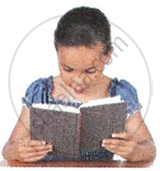 |
- Name the problem she is facing.
- What are the two conditions shown in sections A and B of the eye as applicable to her.
- What kind of reading glasses does she need?
 |
 |
| A | B |
