Advertisements
Online Mock Tests
Chapters
1: Cell Division
2: Structure of Chromosomes
3: Principles of Genetics
Unit-2 Plant Physiology
4: Absorption by Roots
5: Transpiration
6: Photosynthesis
7: Chemical Coordination in Plants
8: Circulatory System
Unit-3 Human Anatomy and Physiology
9: Excretory System
▶ 10: Nervous System
11: Endocrine System
12: Reproductive System
13: Human Population
14: The Evolution of Man
15: Theories of Evolution
16: Types of Pollution
17: Sources of Pollution and Major Pollutants
18: Effects of Pollution
19: Abatement of Pollution
20: Greenhouse Effects, Global Warming, Ozone Layer Depletion and Acid Rain
![Frank solutions for बायोलॉजी पार्ट २ [अंग्रेजी] कक्षा १० आईएससी chapter 10 - Nervous System - Shaalaa.com](/images/biology-part-2-english-class-10-icse_6:4cd9978ddb1c4f42b0b0e9ec6f09c057.jpg "Frank solutions for बायोलॉजी पार्ट २ [अंग्रेजी] कक्षा १० आईएससी chapter 10 - Nervous System")
Advertisements
Solutions for Chapter 10: Nervous System
Below listed, you can find solutions for Chapter 10 of CISCE Frank for बायोलॉजी पार्ट २ [अंग्रेजी] कक्षा १० आईएससी.
Frank solutions for बायोलॉजी पार्ट २ [अंग्रेजी] कक्षा १० आईएससी 10 Nervous System Exercises [Pages 146 - 155]
Choose the correct answer.
More than one foot long cells of the body are __________
gland cell
RBC
bone cell
nerve cell
Choose the correct answer.
The largest part of the brain ____________
medulla
cerebrum
fornix
optic lobe
Number of pairs of cranial nerves in human beings:
10
12
14
20
Choose the correct answer.
Outermost covering of the brain is ______.
dura mater
pia mater
arachnoid
pericardium
Choose the correct answer.
Labyrinth is a part of ____________
ear
brain
nose
eye
Choose the correct answer.
In the chemistry of vision, the photosensitive substance is _________________
melanin
sclerotin
rhodopsin
none
Choose the correct answer.
Rods are receptor of ______________
twilight vision
colour vision
sound wave
odour
Choose the correct answer.
Which one is the photoreceptor _____________
organ of corti
organ of sylvious
cristae
macula
Choose the correct answer.
Synapse is a close proximity of _______________
two veins
two arteries
two muscles
two nerves
Choose the correct answer.
Auditory nerve is responsible for ____________
smell
sight
hearing
none
Choose the correct answer.
Canal joining middle ear to pharynx ___________
eustachian
tympanic
labyrinth
none
Choose the correct answer.
Aperture controlling passage to light into the eye is ___________
blind spot
pupil
iris
cornea
Choose the correct answer.
Colour is detected by ____________
rods
cones
pigment
choroids
Choose the correct answer :
Organ of corti is found in ___________
eye
Ear
skin
none
Choose the correct answer :
The cerebral hemispheres in mammals are connected by _____________
corpus luteum
hypothalamus
pons varolli
corpus callosum
Choose the correct answer :
Presbyopia is a disease of _____________
ear
nose
mouth
eye
The function of rods and cones of a vertebrate retina is to ______.
focus light
amplify light
transduce light
filter light
Choose the correct answer :
In mammals the corpus callosum connects __________
the two optic lobes
the two cerebral hemispheres
the cerebrum to the cerebellum
the pons to the medulla oblongata
Stimulation of nerves of the sympathetic nervous system ______.
Accelerates heartbeat
Constricts pupil of eyes
Increases peristalsis
Retards heartbeat
Vitreous humour is present between ______.
Cornea and Iris
Lens and Retina
Iris and Lens
Cornea and Lens
The ear ossicle that transports sound vibrations to the inner ear:
Stapes
Malleus
Incus
Cochlea
Adjusting the focal length of the eye lens to view objects at different distances is done by ______.
Cornea
Iris
Ciliary muscles
Sclera
Which of the following is not a natural reflex action?
Knee-jerk
Blinking of eyes due to strong light
Salivation at the sight of food
Sneezing when any irritant enters the nose
Following questions consist of two statements - Assertion (A) and Reason (R). Answer these questions by selecting the appropriate option given below:
Assertion (A): Sympathetic nervous system prepares the body for violent action against abnormal conditions.
Reason (R): Sympathetic nervous system accelerates heartbeat.
Which of the following is correct?
Both A and R are True.
A is True, R is False.
A is False but R is True.
Both A and R are False.
Assertion (A): Myopia is the defect of the eye in which only nearer objects are seen clearly by the eye but have difficulty seeing objects that are farther away.
Reason (R): The eyeball is elongated.
Both A and R are True.
A is True, R is False.
A is False but R is True.
Both A and R are False.
Assertion (A): Cyton region of nerve fibre collects information for the brain.
Reason (R): Nerve fibres can either have or lack myelin sheath.
Both A and R are True.
A is True, R is False.
A is False but R is True.
Both A and R are False.
Assertion (A): A nerve impulse is an electrochemical event.
Reason (R): In a nerve impulse there are changes in the resting potential which spreads down the nerve fibre.
Both A and R are True.
A is True, R is False.
A is False but R is True.
Both A and R are False.
Name the following:
Nervous system including brain and spinal cord.
Name the following:
Sympathetic and parasympathetic jointly forms.
Name the following:
Terminal end of spinal cord.
Name the following:
The third neuron that is involved in reflexes, other than simple reflex.
Name the following:
Study of structure and functions of nervous system.
Name the following:
Nerve which carry impulse from sensory receptor to CNS.
Name the following:
The nerve which carry impulse from CNS to muscles.
Name the following:
The peripheral matter of spinal nerve.
Name the following:
The peripheral matter of the brain.
Name the following:
Outermost meningial membrane of spinal cord.
Name the following:
Structural and metabolic unit of nervous tissue.
Name the following:
The biological term given to the protective membranes of the brain.
Name the following:
Cavity in which brain is situated.
Name the following:
The important centre of emotion.
Name the following:
Fissure between the cerebral hemispheres.
Name the following:
The part of the brain associated with memory.
Name the following:
The longest cranial nerve.
Name the following:
White part of the eye.
The ear ossicle which is attached to the tympanum.
Name the following:
Part of internal ear related to balance.
Name the following:
The photosensitive pigment present in the rod cells of the retina.
Name the following:
The internal layers of eye which present reflection of light.
Name the following:
Myopia is corrected using the lens.
Name the following:
The layer of the eyeball that provides nourishment to the eye.
Name the following:
The part of the brain which is concerned with memory.
Name the following:
A defect in our eyes in which some parts of the object are in focus while the other parts are blurred.
Arrange and rewrite the terms in the group in the correct order to be in a logical sequence beginning with the term that is underlined:
Receptor, Response, Effector, Spinal Cord.
Arrange and rewrite the terms in the group in the correct order to be in a logical sequence beginning with the term that is underlined:
Fovea, Lens, Cornea, Coniunctiva.
Arrange and rewrite the term in group in correct order to be in a logical sequence, beginning with the term that is underlined:
Pupil, Aqueous humour, Retina, Vitreous humour.
Arrange and rewrite the terms in group in the correct order to be in a logical sequence, beginning with the term that is underlined:
Effector, Receptor, Motor neuron, Sensory neuron.
Arrange and rewrite the terms in the group in the correct order in a logical sequence beginning with the term that is underlined.
Stimulus, Response, Receptor, Effector, Spinal cord
Arrange and rewrite the terms in the group in the correct order in a logical sequence beginning with the term that is underlined.
Conjunctiva, Yellow spot, Pupil, Vitreous Humor
Differentiate between Spinal nerves and Cranial nerves (number of nerves).
Differentiate between the following pair on the basis of what is mentioned within brackets.
Cerebrum and Spinal cord (Arrangement of nerve cells)
Differentiate between the following pair on the basis of what is mentioned within brackets.
Myopia and Hypermetropia (Change of the defect)
Differentiate between near vision and distant vision (Shape of the eye lens).
Choose the odd one out from the following terms and name the category to which the others belong.
Retina, Sclera, Ciliary body, Nephron
Choose the odd one out from the following terms and name the category to which the others belong.
Endolymph, Tympanic membrane, Semi-circular canal, Blind spot
Choose the odd one out from the following terms and name the category to which the others belong.
Prosencephalon, Mesencephalon, Rhombencephalon, Myelin
Choose the odd one out from the following terms and name the category to which the others belong.
Cerebellum, Medulla oblongata, Olfactory lobe
Choose the odd one out from the following terms and name the category to which the others belong.
Parasympathetic, Sympathetic, Cranial nerve
Choose the odd one out from the following terms and name the category to which the others belong:
Malleus
Incus
Cochlea
Stapes
Match the terms of column I with those of column ll
| Column l | Column ll |
| (i) Lens | (a) Adjustment of light rays |
| (ii) Lachrymal gland | (b) Vision |
| (iii) Olfactory epithelium | (c) Secretion of tear |
| (iv) Cochlea | (d) Balance of the body |
| (v) Semicircular canal | (e) Hearing |
| (vi) Eyes | (f) Smell |
Give the function of the following structure:
Ear pinna
Give the function of the following structure:
External auditory meatus
Give the main function of the following:
Cochlea
Give the function of the following structure:
Semicircular canals
Give the function of the following structure:
Lachrymal gland
State the functions of the following:
Eyelids
Give the function of the following structure:
Retina
Give the function of the following structure:
Eye lens
Give the function of the following structure:
Pupil
Give the function of the following structure:
Olfactory lobe
Give the function of the following structure:
Optic lobe
Write the function of medulla oblongata.
Define the following:
Nerve impulse
Define the following:
Axon
Define the following:
Cyton
Define the following:
Action potential
Define the following:
Reflex action
Define the following:
Yellow spot
Define the following:
Blind spot
Define the following:
Power of accommodation
Distinguish between the following pair of words:
Nervous system and hormonal system
Distinguish between the following pair of words:
Cerebrum and cerebellum
Distinguish between the following pair of words:
Adrenalin and acetylcholine
Distinguish between the following pair of words:
Motor and sensory nerve
Distinguish between the following pair of words:
Grey matter and white matter
Give the main function of the following:
Cochlea
Give the main function of the following:
Fovea centralis
Give the main function of the following:
Three semicircular canals
Give the function of the following structure:
Retina
Give the function of the following structure:
Lachrymal gland
Give the main function of the following:
Meninges
Write whether the following is true or false:
Axon of one neuron communicates with other nerve cell through synapse.
True
False
Write whether the following is true or false:
Neurotransmitters are released on activation.
True
False
Write whether the following is true or false:
Neurotransmitters are either broken down or reabsorbed after they have conducted an impulse.
True
False
Write whether the following is true or false:
All voluntary actions are controlled by the cerebellum.
True
False
Write whether the following is true or false:
A convex lens is used for correcting myopia.
True
False
Write whether the following is true or false:
Rods are the receptor cells in the retina of the eye sensitive to dimlight.
True
False
Write whether the following is true or false:
The part of the ear associated with balance is the cochlea.
True
False
Write whether the following is true or false:
Vitreous chamber is present in ear in humans.
True
False
Mention, if the following statement is True or False
Deafness is caused due to the rupturing of the pinna.
True
False
Give the biological/technical term for the following:
Protective coverings located around the human brain and spinal cord.
Where is this located?
Meninges
Where is this located?
Ganglia
Where is this located?
Cerebellum
Where is this located?
Nodes of Ranvier
Where is this located?
Effector organs
State the exact location of the following structure.
Dura mater
Correct the following statement by changing the underlined word.
The outermost layer of Meninges is Pia mater.
Perilymph or endolymph (Which one surrounds the organ of Corti?)
Sclerotic layer or choroid layer (Which one forms the Iris?)
Choose the ODD one out from the following terms given and name the CATEGORY to which the others belong:
Dendrites, Medullary sheath, Axon, Spinal cord
State the Location of:
Lacrimal gland
Mention the exact location of the malleus.
State the exact location of the following structure.
Islets of Langerhans
What is a reflex action?
Give one example of a conditioned reflex in your own life.
Name the respective organs in which the following are located and mention the main function of each:
(i) Iris
(ii) Semicircular canals
What is a reflex action?
Draw neat and labelled diagrams of a myelinated neuron
Label the following diagram:
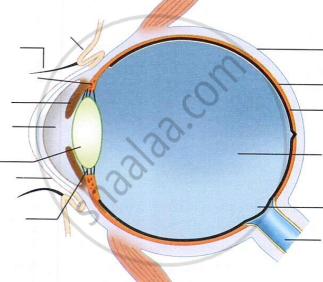
Label the following diagram:
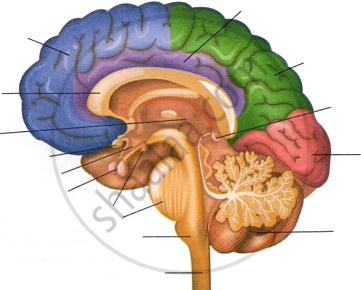
Draw a well-labelled diagram of the vertical section of mammalian brain.
Which part of the brain is the seat of body temperature regulation?
Name the part of the brain responsible for sense of smell and mental function of intelligence and memory .
Draw a diagram of the side view of human brain and label the part which suits the following functions/ descriptions:
(i) It lies below and behind the cerebrum. It consists of three parts.
(ii) It is a cross-wise broad band of fibres which comments medulla oblongata, cerebellum and cerebrum.
(iii) It is the lower most and hinder part of the brain which continues below into spinal cord
(iv) It is a small thick-walled area which lies hidden below the cerebrum.
(v) It is the largest part of the brain which constitutes more than 80% and possesses 6-7 billion neurons.
(vi) It takes part in relaying sensory impulses and regulation of smooth muscle activity?
The diagram shows a section of the human brain.
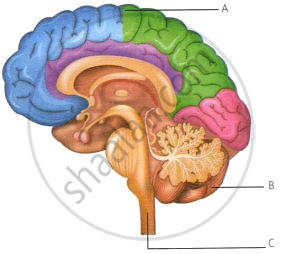
Answer the questions that follow:
- Name the parts labelled A, B and C.
- Give the main function of each of the parts A, B and C.
- Name the three protective membranes covering the brain.
- Name the basic unit of the brain.
The diagram alongside represents the structure of the human ear. Study the same and answer the questions that follow.
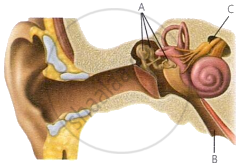
- Give the biological term for the part labelled ‘A’ and state its function.
- Name the part labelled ‘B’.
- Name the part labelled ‘C’.
- Give the function of ear wax.
The diagram alongside represents the structure found in the inner ear. Study the same and then answer the questions that follow:
(i) Name the parts labelled A, B, C and D.
(ii) Name the parts of the ear responsible for transmitting impulses to the brain.
(iii) Name the part labelled above which is responsible for:
1. Static equilibrium. 2. Dynamic equilibrium. 3. Hearing
(iv) Name the audio receptor cells which pick up vibrations.
(v) Name the fluid present in the inner ear.

The diagram alongside represents a certain defect of vision of the human eye.
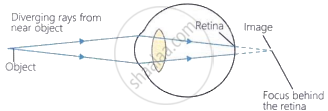
- Name the defect.
- Describe briefly the condition in the eye responsible for the defect.
- Redraw the figure by adding a suitable lens correcting the defect. Label the parts through which light rays pass.
The diagram alongside represents a section of a mammalian eye.
(i) Label the parts 1 to 5 of the diagram.
(ii) State the function of the parts labelled 4 and 5.
(iii) With the help of a diagram show the short sightedness.

Given alongside is a diagram depicting a defect of the human eye. Study the same and then answer the questions that follow:
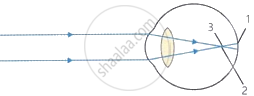
- Identify the defect.
- Name the parts labelled 1, 2 and 3.
- Give two possible reasons for this eye defect.
- Draw a labelled diagram to show how the above mentioned defect is rectified.
Draw a diagram of the human eye as seen in a vertical section and label the parts which suit the following descriptions relating to the:
(i) photosensitive layer of the eye.
(ii) structure which is responsible for holding the eye lens in its position.
(iii) structure which maintains the shape of the eyeball and the area of no vision.
(iv) anterior chamber seen in front of the eye lens.
(v) outermost transparent layer seen in front of the eyeball.
The diagram given alongside is a representation of a certain phenomenon pertaining to the nervous system. Study the diagram and answer the following questions:
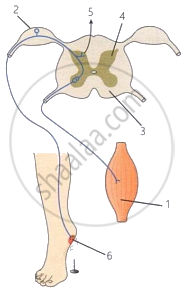
- Name the phenomenon that is being depicted.
- Give the technical term for the point of contact between the two nerve cells.
- Name the parts 1, 2, 3, and 4.
- Write the functions of parts 5 and 6.
- How does the arrangement of neurons in the spinal cord differ from that of the brain?
Given alongside is a diagram depicting a defect of the human eye. Study the same and then answer the questions that follow:
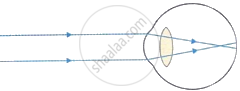
- Name the defect shown in the diagram.
- What are the two possible reasons that cause this defect?
- Name the type of lens used to correct this defect.
- With the help of a diagram, show how the defect shown above is rectified using a suitable lens.
- Draw a well-labelled diagram of the membranous labyrinth found in the inner ear.
- Based on the diagram drawn above in (i), give a suitable term for each of the following descriptions:
- The sensory cells that help in hearing.
- The part that is responsible for static balance of the body.
- The membrane-covered opening that connects the middle ear to the inner ear.
- The fluid present in the middle chamber of cochlea.
- The structure that maintains dynamic equilibrium of the body.
The diagram given below is an external view of the human brain. Study the same and answer the questions that follow:

- Name the parts labelled A, B and C in the diagram.
- State the main functions of the parts labelled A and B.
- What are the structural and functional units of the brain? How are the parts of these units arranged in A and C?
- Mention the collective term for the membranes covering the brain.
- What is the function of cerebrospinal fluid?
The diagram given below shows the internal structure of a spinal cord depicting a phenomena. Study the diagram and answer the questions:
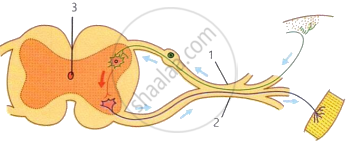
- Name the phenomenon that is depicted in the diagram. Define the phenomenon.
- Give the technical term for the point of contact between the two nerve cells.
- Name the parts numbered 1, 2 and 3.
- How does the arrangement of neurons in the spinal cord differ from that of the brain?
- Mention two ways by which the spinal cord is protected in our body.
Name the type of nerve which has the fibres of both sensory and motor neurons.
Which part of the human ear gives ‘Static balance’ to the body?
Which part of the human ear gives ‘ Dynamic balance’ to the body?
Answer the following questions briefly.
What is a reflex action?
The renal cortex has a dotted appearance, and the Renal medulla has a striped appearance. Explain.
Give any two functions of cerebellum.
Distinguish between Semicircular canals and Utriculus based on their function.
Answer the following questions briefly:
How are the cytons and axons placed in the brain and the spinal cord?
Which part of the human ear gives ‘ Dynamic balance’ to the body?
Answer the following questions briefly:
Explain how the human eye adapts itself to bright light and dim light.
The diagram given below depicts a defect of the human eye which has been corrected by using a suitable lens. Answer the following questions:
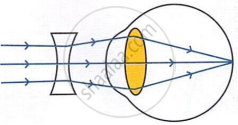
- Name the defect that has been corrected. Which type of lens has been used for the correction?
- Mention one cause for the above defect.
- Where would the image have formed if the above lens was not used for correction?
- Name the three concentric layers of the eyeball.
- Draw a neat, labelled diagram of a neuron.
Mohan is fond of playing basketball. His concentration is on shooting the ball into the opponent's basket as given in the picture.

- Which part of the brain helps Mohan to concentrate in putting the ball into the basket?
- Name the sense organ that helps to gauge the distance between the ball and the basket.
- Name the part of the brain that co-ordinates all the voluntary muscles of his body.
A teacher drew the diagram of the heart on the blackboard and told the students to copy it in their notebooks. Mahesh couldn't see the diagram clearly as it appeared blurred to him.
- Name the defect of the eye Mahesh is suffering from.
- Where is the image formed in this defect?
- Mahesh consults an eye doctor and is prescribed suitable lenses to correct the defect. Which type of lens do his spectacles have?
Solutions for 10: Nervous System
Frank solutions for बायोलॉजी पार्ट २ [अंग्रेजी] कक्षा १० आईएससी chapter 10 - Nervous System
Shaalaa.com has the CISCE Mathematics बायोलॉजी पार्ट २ [अंग्रेजी] कक्षा १० आईएससी CISCE solutions in a manner that help students grasp basic concepts better and faster. The detailed, step-by-step solutions will help you understand the concepts better and clarify any confusion. Frank solutions for Mathematics बायोलॉजी पार्ट २ [अंग्रेजी] कक्षा १० आईएससी CISCE 10 (Nervous System) include all questions with answers and detailed explanations. This will clear students' doubts about questions and improve their application skills while preparing for board exams.
Further, we at Shaalaa.com provide such solutions so students can prepare for written exams. Frank textbook solutions can be a core help for self-study and provide excellent self-help guidance for students.
Concepts covered in बायोलॉजी पार्ट २ [अंग्रेजी] कक्षा १० आईएससी chapter 10 Nervous System are Major Division of the Nervous System, Transmission and Generation of Nerve Impulse, The Spinal Cord, Reflex Action, Peripheral Nervous System (PNS), Types of Reflexes, Nervous Pathways in Reflexes, Reflex Arc, Complex Reflex Action, Synapse, Human Nervous System, Kinds of Nerves, Types of Neurons, Nerves, The Human Brain, Parts of the Brain > Cerebrum, Parts of the Brain > Cerebellum, Parts of the Brain > Medulla Oblongata, Primary Regions of the Brain, Autonomic Nervous System (ANS), Involuntary Actions Vs Voluntary Actions, Pavlov's Experiment on a Dog, Reflexes in Humans, Human Eye, Defects of Vision and Their Corrections > Myopia, Defects of Vision and Their Corrections > Hypermetropia, Defects of Vision and Their Corrections > Presbyopia, Eye Defect and Its Correction: Astigmatism, Common Defects of the Eye, Stereoscopic (Binocular) Vision, Concept of Sense Organs, Sensory Receptors, Structure of the Eyeball, Yellow Spot and Blind Spot, Rods Vs Cones, Lens, Light and Dark Adaptation, Colour Vision, Colour Blindness Assessment, After-Images and Visual Illusions of Vision, Eye Donation, Human Ear, Functions of the Ear, Major Division of the Nervous System, Transmission and Generation of Nerve Impulse, The Spinal Cord, Reflex Action, Peripheral Nervous System (PNS), Types of Reflexes, Nervous Pathways in Reflexes, Reflex Arc, Complex Reflex Action, Synapse, Human Nervous System, Kinds of Nerves, Types of Neurons, Nerves, The Human Brain, Parts of the Brain > Cerebrum, Parts of the Brain > Cerebellum, Parts of the Brain > Medulla Oblongata, Primary Regions of the Brain, Autonomic Nervous System (ANS), Involuntary Actions Vs Voluntary Actions, Pavlov's Experiment on a Dog, Reflexes in Humans.
Using Frank बायोलॉजी पार्ट २ [अंग्रेजी] कक्षा १० आईएससी solutions Nervous System exercise by students is an easy way to prepare for the exams, as they involve solutions arranged chapter-wise and also page-wise. The questions involved in Frank Solutions are essential questions that can be asked in the final exam. Maximum CISCE बायोलॉजी पार्ट २ [अंग्रेजी] कक्षा १० आईएससी students prefer Frank Textbook Solutions to score more in exams.
Get the free view of Chapter 10, Nervous System बायोलॉजी पार्ट २ [अंग्रेजी] कक्षा १० आईएससी additional questions for Mathematics बायोलॉजी पार्ट २ [अंग्रेजी] कक्षा १० आईएससी CISCE, and you can use Shaalaa.com to keep it handy for your exam preparation.
