Advertisements
Online Mock Tests
Chapters
1: Cell Division
2: Structure of Chromosomes
3: Principles of Genetics
Unit-2 Plant Physiology
4: Absorption by Roots
5: Transpiration
6: Photosynthesis
7: Chemical Coordination in Plants
8: Circulatory System
Unit-3 Human Anatomy and Physiology
9: Excretory System
10: Nervous System
11: Endocrine System
▶ 12: Reproductive System
13: Human Population
14: The Evolution of Man
15: Theories of Evolution
16: Types of Pollution
17: Sources of Pollution and Major Pollutants
18: Effects of Pollution
19: Abatement of Pollution
20: Greenhouse Effects, Global Warming, Ozone Layer Depletion and Acid Rain
![Frank solutions for बायोलॉजी पार्ट २ [अंग्रेजी] कक्षा १० आईएससी chapter 12 - Reproductive System - Shaalaa.com](/images/biology-part-2-english-class-10-icse_6:4cd9978ddb1c4f42b0b0e9ec6f09c057.jpg "Frank solutions for बायोलॉजी पार्ट २ [अंग्रेजी] कक्षा १० आईएससी chapter 12 - Reproductive System")
Advertisements
Solutions for Chapter 12: Reproductive System
Below listed, you can find solutions for Chapter 12 of CISCE Frank for बायोलॉजी पार्ट २ [अंग्रेजी] कक्षा १० आईएससी.
Frank solutions for बायोलॉजी पार्ट २ [अंग्रेजी] कक्षा १० आईएससी 12 Reproductive System Exercise [Pages 178 - 182]
Choose the correct answer:
The aim of sexual reproduction _________
over production
continuity of race
low production
none
Choose the correct answer:
Binary fission is a method of __________
parthenogenesis
asexual reproduction.
sexual reproduction
none
Choose the correct answer:
Ovum is a ______________
male gamete
female gamete
a chemical
a fibre
Reproduction from an ovum without fertilization is ______.
sexual reproduction
asexual reproduction
parthenogenesis
abiogenesis
Choose the correct answer:
Cervix is a part of ________________
ovary
vagina
uterus
oviduct
Choose the correct answer:
Fertilization occurs in _____________
uterus
oviduct
ovary
vagina
Choose the correct answer:
The onset of menstruation in the female is termed __________
ovulation
menarche
menopause
parthenogenesis
Choose the correct answer:
Temperature of scrotum is ______________
20C above body temperature
same as body temperature
20-30C below the body temperature
none of the above
Choose the correct answer:
First menstrual cycle is known as ___________
menopause
amenorrhoea
puberty
Menarche
Choose the correct answer:
When pregnancy does not occur, the life of corpus luteum is about _____________
4 days
10 days
14 days
28 days
The site of maturation of human sperms is the
Seminiferous tubule
Interstitial cells
Epididymis
Prostate gland
Haploid number of chromosomes are found in ______.
Nephrons
Neurons
Skin cells
Sperms
The fusion of the sperm and ovum is termed as ______.
Reproduction
Development
Fertilization
Embryo
In a human female, ovum consists of ______.
23 pairs of autosomes
22 pairs of autosomes and I pair of sex chromosomes
22 autosomes and 1 Y-chromosome
22 autosomes and 1 X-chromosome
Assertion (A): The testes of males are primary sex organs.
Reason (R): The ovaries of females are secondary sex organs.
Both A and R are true and R is the correct explanation of A.
Both A and R are true but R is not the correct explanation of A.
A is true but R is false.
A is false but R is true.
Assertion (A): Each ovary is covered by a thin epithelium.
Reason (R): The stroma of ovary is divided into peripheral cortex and inner medulla.
Both A and R are true and R is the correct explanation of A.
Both A and R are true but R is not the correct explanation of A.
A is true but R is false.
A is false but R is true.
Name the following:
Organ producing sperms.
Name the following:
Organ producing ovum.
Name the following:
Organ where implantation takes place.
Name the following:
Organ where fertilization occurs.
Name the following:
Fusion of sperm and ovum.
Name the following:
Male and Female organs on specific individuals.
Name the following:
Male and Female organs on specific individuals.
Name the following:
The part of ovary that produces progesterone.
Name the following:
Produces male gametes in man.
Name the following:
The structure which connects the placenta and the foetus.
Name the following:
The permanent stoppage of menstruation in human females around the age of 45 years.
Name the Following:
The process of attachment of fertilized ovum to the uterine wall.
Complete the following statement by choosing the correct alternative:
Male copulatory organ ______.
clitoris
penis
vulva
Complete the following statement by choosing the correct alternative:
Female copulatory organ ______.
vulva
vagina
penis
Complete the following statement by choosing the correct alternative:
Fertilization occurs in ______.
uterus
oviduct
ovary
Complete the following statement by choosing the correct alternative:
Menstrual flow is a character is the feature of ______.
male
female
bulb
Complete the following statement by choosing the correct alternative:
Sterilization in female is due to cutting off of ______.
ovary
uterus
oviduct
State whether the following statement is true or false:
Fertilization occurs in the vagina.
True
False
State whether the following statement is true or false:
Gestation in humans is completed in about 380 days.
True
False
State whether the following statement is true or false:
Oviducts and fallopian tubes are one and the same thing.
True
False
One egg is released from each of the two ovaries every month.
True
False
The vagina is a muscular tube.
True
False
Give appropriate term of the following:
The onset of reproductive phase in a young female.
Give appropriate term of the following:
The rupture of follicle and release of ovum from the ovary.
Give appropriate term of the following:
The monthly discharge of blood and disintegrated uterine tissues in human female.
Give appropriate term of the following:
The process of fusion of ovum and sperm.
Give appropriate term of the following:
The attachment of developing zygote (blastocyst) on the uterine wall.
Give an appropriate term for the following:
The birth of twins from two fertilized eggs.
Give the functions of the following:
Ovary
Mention the functions of Oviduct.
Give the function of the following:
Uterus
Give the functions of the following:
Vagina
Give the functions of the following:
Testes
Give the functions of the following:
Penis
Define the following:
Parthenogenesis
Define the following:
Asexual reproduction
Define the following:
Sexual reproduction
Define the following:
Parturition
Define the following:
Ovulation
Define the following:
Spermatogenesis
Define the following:
Gestation
Define the following:
Implantation
Choose the odd one out from the following terms and name the category to which the others belong:
Menstrual phase
Telophase
Follicular phase
Luteal phase
Rewrite the terms in the correct order so as to be in a logical sequence.
Sperm duct, penis, testes, sperms, semen.
Rewrite the terms in the correct order so as to be in a logical sequence.
Implantation, ovulation, child birth, gestation, fertilisation.
Rewrite the terms in the correct order so as to be in a logical sequence.
ovum, uterus, fallopian tube, ovary, graffian follicle
Rewrite the terms in the correct order so as to be in a logical sequence.
vagina, ovary, uterus, oviduct, cervix
Rewrite the terms in the correct order so as to be in a logical sequence.
testis, urethra, sperm duct, epididymis
Distinguish between the following pair:
Implantation and gestation
Distinguish between human sperm and ovum.
Differentiate between:
Corpus luteum and Corpus albicans
Differentiate between:
Gametogenesis and Spermatogenesis
Draw a labeled diagram of human ovum.
Draw a labeled diagram of sperm.
Mention the exact location of the epididymis.
Give appropriate biological or technical terms for the following:
The onset of menstruation in a young girl
Give an appropriate biological or technical term for the following:
The fluid which surrounds the foetus.
Differentiate between the following pairs on the basis of what is indicated in the brackets.
Testosterone and Oestrogen (Organ which secretes)
Give a biological explanation for the following.
The placenta is an important structure for the development of a foetus.
Label the following diagram.
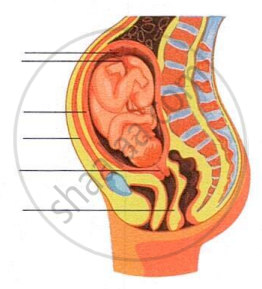
Draw the outline of male reproduction system and label the following parts.
Testis, epididymis, Seminal vesicle, Vas deferens.
Name the hormone secreted by the following gland:
Testes
Why are sperms produced in large numbers?
State the function of Seminal vesicle.
The diagram alongside is the vertical section of female reproductive organs. Study the diagram and answer the questions that follow:
- Name the fully developed part of ovary containing the ovum.
- Name the organ of the female body in which the foetus develops.
- What is ovulation?
- Which two hormones are secreted by ovary?
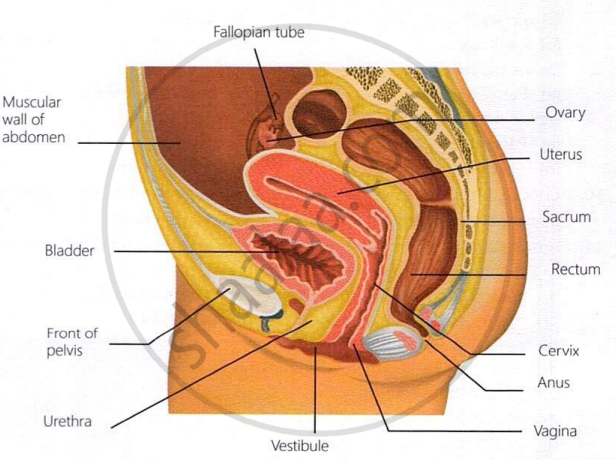
Draw a diagram to display the vertical view of human female reproductive system and label the following parts in the diagram:
(1) Ureter
(2) Ovary
(3) Funnel of fallopian tube
(4) Urethra.
What happens to uterus if fertilization takes place? And what happens to uterus if fertilization does not take place?
Answer the following questions.
Normally, after how many days does an ovary release an egg?
Where are the sperms released during coitus?
What is the role of sperms after their ejaculation in vagina?
What is the gestation period in human?
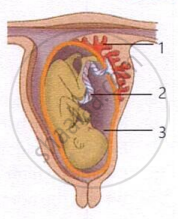
The diagram given below is that of a developing human foetus. Study the diagram and then answer the questions that follow:
- Label the parts numbered 1 to 3 in the diagram.
- Mention any two functions of the part labelled 2 in the diagram.
- Explain the significance of the part numbered 3 in the diagram.
- Define the term ‘Gestation’. What is the normal gestational period of the developing human embryo?
- Mention the sex chromosomes in a male and female embryo.
The diagram below represents two reproductive cells A and B. Study the same and then answer the questions that follow:
 |
- Identify the reproductive cells A and B.
- Name the specific part of the reproductive system where the above cells are produced.
- Where in the female reproductive system do these cells unite?
- Name the main hormones secreted by the (1) ovary (2) testes.
- Name an accessory gland found in the male reproductive system and state the function of its secretion.
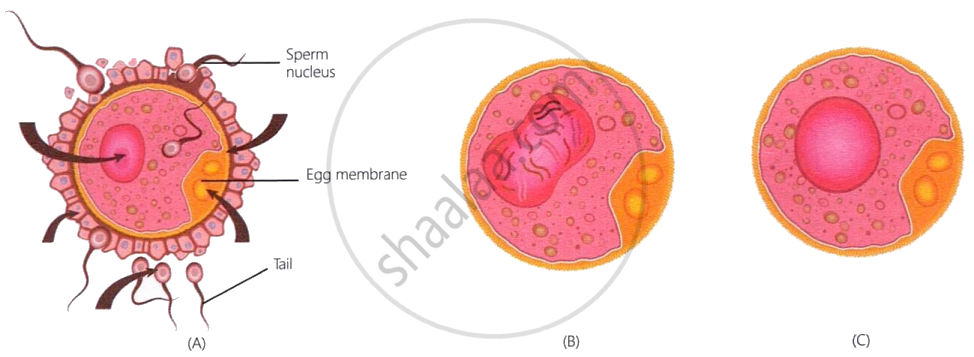
Given below are diagrams showing the different stages in the process of fertilisation of an egg in the female reproductive tract. Study the diagrams and answer the questions:
- Arrange the letters given below each diagram in a logical sequence to show the correct order in the process of fertilisation.
- Where does fertilisation normally take place? What is ‘implantation’ that follows fertilisation?
- Mention the chromosome number of the egg and zygote in humans.
- Explain the term ‘gestation’. How long does gestation last in humans?
- Draw a neat labelled diagram of a mature human sperm.
Mention any two functions of the human foetal placenta.
What is the significance of the testes being located in scrotal sacs outside the abdomen?
State the exact location of the following structure:
Amniotic gland
Mention the exact location of the following:
Testis
The diagram given below is that of a developing human foetus. Study the diagram and then answer the questions that follow:
- Label the parts numbered 1 to 3 in the diagram.
- Mention any two functions of the part labelled 2 in the diagram.
- Explain the significance of the part numbered 3 in the diagram.
- Define the term ‘Gestation’. What is the normal gestational period of the developing human embryo?
- Mention the sex chromosomes in a male and female embryo.

The diagram given below shows a section of the human ovary.
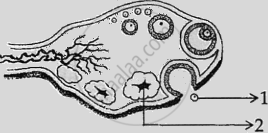
- Name the process for the release of the part labelled 1.
- Write the name of the structure marked 2.
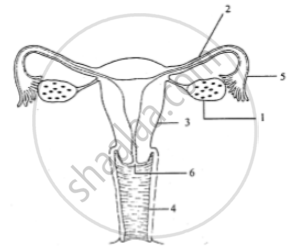
The diagram given below represents a system in the human body. Study the diagram and answer the following questions:
- Identify the system.
- Label the parts marked 5 and 6.
- Name the two hormones secreted by 1.
- Mention the number and the name of the part involved in fertilization and implantation from the above diagram.
- Mention the surgical methods of contraception in:
- Human males.
- Human females.
Solutions for 12: Reproductive System
Frank solutions for बायोलॉजी पार्ट २ [अंग्रेजी] कक्षा १० आईएससी chapter 12 - Reproductive System
Shaalaa.com has the CISCE Mathematics बायोलॉजी पार्ट २ [अंग्रेजी] कक्षा १० आईएससी CISCE solutions in a manner that help students grasp basic concepts better and faster. The detailed, step-by-step solutions will help you understand the concepts better and clarify any confusion. Frank solutions for Mathematics बायोलॉजी पार्ट २ [अंग्रेजी] कक्षा १० आईएससी CISCE 12 (Reproductive System) include all questions with answers and detailed explanations. This will clear students' doubts about questions and improve their application skills while preparing for board exams.
Further, we at Shaalaa.com provide such solutions so students can prepare for written exams. Frank textbook solutions can be a core help for self-study and provide excellent self-help guidance for students.
Concepts covered in बायोलॉजी पार्ट २ [अंग्रेजी] कक्षा १० आईएससी chapter 12 Reproductive System are Reproduction, The Female Reproductive System, Menstrual Cycle (Ovarian Cycle), Role of Hormones in Reproduction, Parturition (Birth) in Human, Human Reproduction, The Male Reproductive System, Placenta (Growth) in Human, Twins - Fraternal & Identical, Multiple Births: Triplets, Quadruplets, etc., Reproduction, The Female Reproductive System, Menstrual Cycle (Ovarian Cycle), Role of Hormones in Reproduction, Parturition (Birth) in Human, Human Reproduction, The Male Reproductive System, Placenta (Growth) in Human, Twins - Fraternal & Identical, Multiple Births: Triplets, Quadruplets, etc..
Using Frank बायोलॉजी पार्ट २ [अंग्रेजी] कक्षा १० आईएससी solutions Reproductive System exercise by students is an easy way to prepare for the exams, as they involve solutions arranged chapter-wise and also page-wise. The questions involved in Frank Solutions are essential questions that can be asked in the final exam. Maximum CISCE बायोलॉजी पार्ट २ [अंग्रेजी] कक्षा १० आईएससी students prefer Frank Textbook Solutions to score more in exams.
Get the free view of Chapter 12, Reproductive System बायोलॉजी पार्ट २ [अंग्रेजी] कक्षा १० आईएससी additional questions for Mathematics बायोलॉजी पार्ट २ [अंग्रेजी] कक्षा १० आईएससी CISCE, and you can use Shaalaa.com to keep it handy for your exam preparation.
